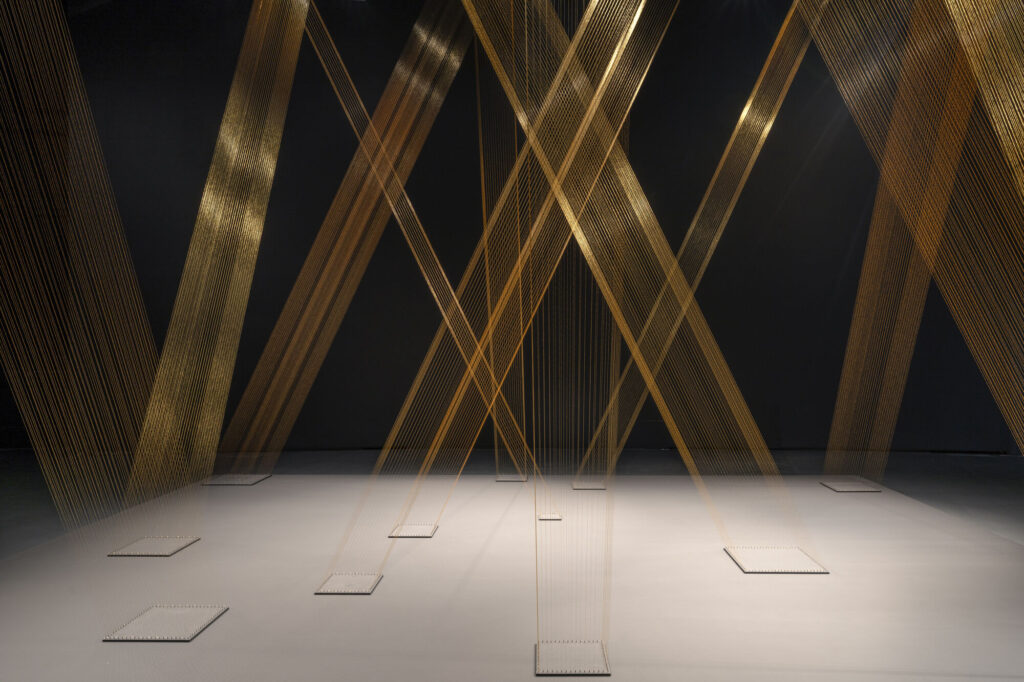
Lygia Pape (1927-2004)
Ttéia 1, C, 2003-2025
Golden thread, wood, nails, light
Variable dimensions
Pinault Collection
Photo: Nicolas Brasseur/Pinault Collection
At the end of last year, the exhibition Minimal was on view at La Bourse – Pinault Collection in Paris. It was a remarkable exhibition, featuring first-rate works from the Pinault Collection itself as well as from the renowned Dia Art Foundation, of which guest curator Jessica Morgan is director. A special edition of Beaux Arts accompanied the exhibition and opened with an interview with Morgan. “Why is the exhibition called Minimal rather than Minimalism?” Her answer is surprising—not so much because of the argument itself, but because it comes from someone who for a decade has presided over what is often regarded as the mecca of American minimal art, and who, with this exhibition, seems almost to relinquish the proprietary claim to an almost exclusively American ‘ism’ in which the DIA has played a leading role.
She advances a familiar argument: “the artists never accepted the term.” Her second point also strikes a chord: it is high time to counter the rigidity of the concept. History, she argues, is more complex than often presented and extends far beyond the United States. Hence her decision to include artists from Japan, Latin America and Europe. This did not result in a geographically organised exhibition, nor in a complex (art) historical narrative, but rather in a lucid thematic structure and an introduction to several lesser-known names. Seven themes were explored: Light, Mono-ha (the name of a Japanese artists’ group), Balance, Surface, Grid, Monochrome and Materialism. Formalistic? Certainly. Does it go beyond that? Not really—except that the choice itself conveys a message. Whether that suffices, I’ll leave to those who saw the exhibition. From the walls, somewhat discreetly, sounded familiar strains by the American minimalist composer Steve Reich, the Japanese composer Yoshi Wada, Pauline Oliveros—American, though of Texan (Latino) descent—and, from Europe, Iannis Xenakis.
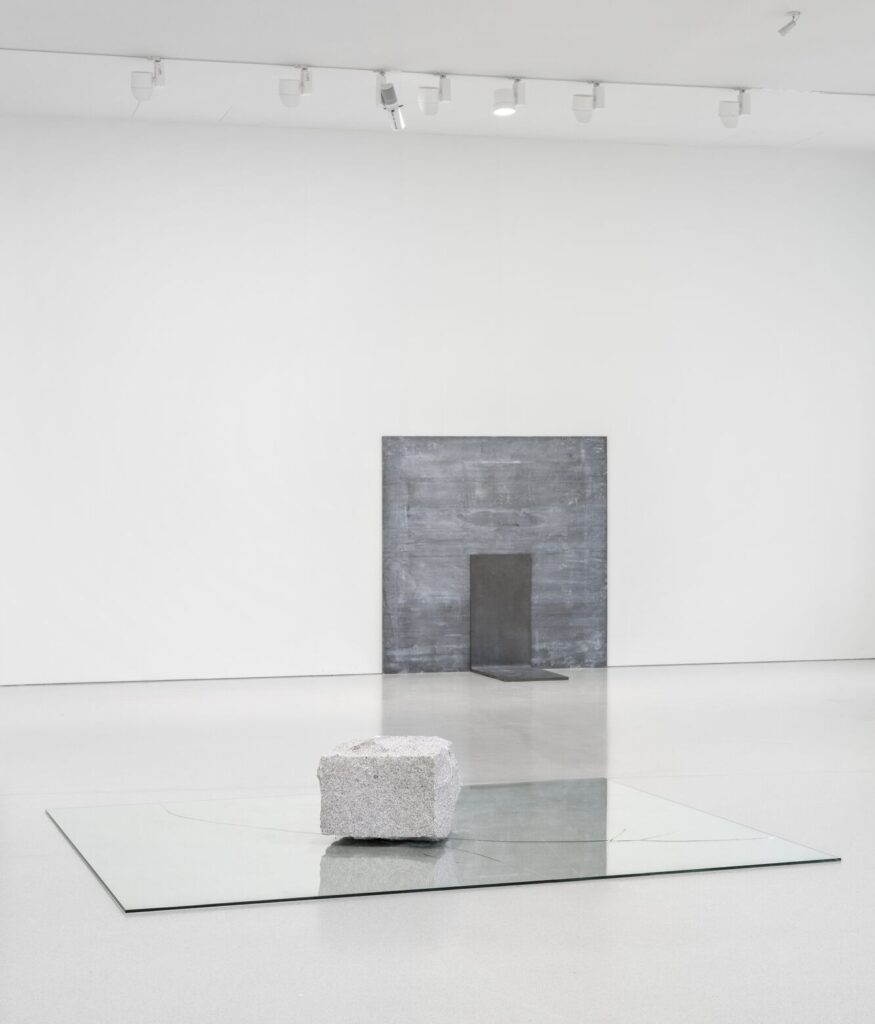
In the front:
Lee Ufan (1936)
Relatum (formerly Phenomena and Perception B) , 1969-2012
Glass and stone
Pinault Collection
Photo: Nicolas Brasseur/Pinault Collection
Minimal Music
The biennial Amsterdam Minimal Music Festival, soon to take place again, addressed the broadening of the old concept of Minimal Music somewhat earlier, though differently. What began as the World Minimal Music Festival has for some time now been known simply as the Minimal Music Festival.1 Under its original name, it initially revolved around a limited number of American composers. The first edition centred primarily on Reich; the following edition added Philip Glass, La Monte Young, Terry Riley, and the Dutch composer Simeon ten Holt. Two years later, Louis Andriessen’s De Tijd was performed, followed in a subsequent edition by De Materie. From then on, Andriessen’s name was routinely added to the American roster. Why? Maybe because he built a career in the United States and absorbed the influence of minimal music there? Let us simply say that he belongs within this festival’s framework. Other composers were introduced during these years through their followers, while the Americans came to be referred to as ‘the pioneers’.
This dichotomy gradually faded: organisers increasingly preferred to speak of ‘minimal music in the broadest sense’. More recently, the discourse has shifted towards the language of experience: hypnotic, transcendental and immersive—the ultimate contemporary qualification, deployed both aptly and, more often, inappropriately, as a marketing lure. The terminology is particularly popular in sound art and media art, especially in relation to VR works, often regarded as the crown jewels of immersive experience. In the publicity for the forthcoming festival, an immersive experience is predicted for a performance by Charlemagne Palestine.
Immersive Experiences
When is the term immersive experience used appropriately? In a thesis written ten years ago by one of my students, Akkemay Lammers, that was not the central question2. Instead, she ‘only’ examined the factors that play a role in immersive experiences within media art, particularely in relation to video art installations. Although by then I had already donned the headset of a VR installation on numerous occasions, the term had not yet become so firmly embedded in marketing discourse as it is today. The immersive experience of a VR installation is, in essence, a technical matter: predominantly a visual spatio-temporal experience, with an auditory equivalent. A fine example of an immersive experience exclusively based on sound, still vivid in my memory, is Atmos/Spheres II, a production by Dyane Donck Company and Orkest de Ereprijs, consisting of sixty-four spatially positioned speakers of a Dolby Atmos sound system combined with live music. It was one of the most impressive sonic experiences I have ever encountered. In Claire Bishop’s terminology, this would be described as mimetic engulfment.
VR, however, is not fundamentally about a distinctive individual experience of time and space—whether defined as sensory or emotional—though it is often presented as such. Rather, it concerns the technological capacity of an installation, via headset and headphones, to envelop the user, who may then interact within the parameters—and significant limitations—of the programme. The immersive experience of the video installation operates on another level altogether.3 On the one hand, it continually escapes definition in purely technical terms; on the other, it is virtually impossible to predict its effect upon the viewer. Lammers selected diverse and compelling case studies into which she immersed herself, using her own experience as the measure of selection while drawing upon various theoretical frameworks, particularly regarding the importance of the space-time experience, which she reframed as spatio-temporal freedom. This quality proved decisive in her first case: the labyrinthine video installation exhibition by Ed Atkins at the Stedelijk Museum Amsterdam. Sound in multiple forms dominated the entire space; the audio of individual works flowed seamlessly into one another in a carefully orchestrated manner.
Her second case was Nummer zestien: The present moment (2016) by Guido van der Werve. In every respect the antithesis of Atkins’ exhibition. Van der Werve created the installation for the oldest church in Amsterdam, where light is filtered through stained-glass windows. He constructed a compelling cinematic arrangement with three video screens and a fixed starting time. The screens presented side by side three forms of human interaction, described in reviews as mechanical and apathetic. The listlessness of the imagery shifted viewing from a cinematic mode to the more active engagement typical of multi-channel installations. Sound emanated primarily from a single source: a pianola placed in the space, performing Van der Werve’s own restrained composition. Compared with Atkins’ exhibition, the overall effect of the video was anti-spectacular. However, together with the impressive setting of the church and the music it was decisive in shaping the immersive experience. That experience shifted markedly when couples appeared on the right-hand screen engaged in sexual acts which, as Lammers writes, destabilised the spectator: a reality check that generated a different form of involvement from that of immersion and contemplation. Shall we call it voyeuristic?
Compared with VR, this shift—from virtual to real, from staged to documentary, from guided to freely navigated perception—is a strength rather than a limitation of video installation. One might have expected that the recent incorporation of AI into VR would intensify immersion through the realisation of a ‘dream scene’ (Claire Bishop). That has not (yet) proved to be the case. The choices VR offers remain framed—because programmed—and do not result in genuine immersion, let alone self-loss. In this case the reality check continues to impede the user’s full immersion.
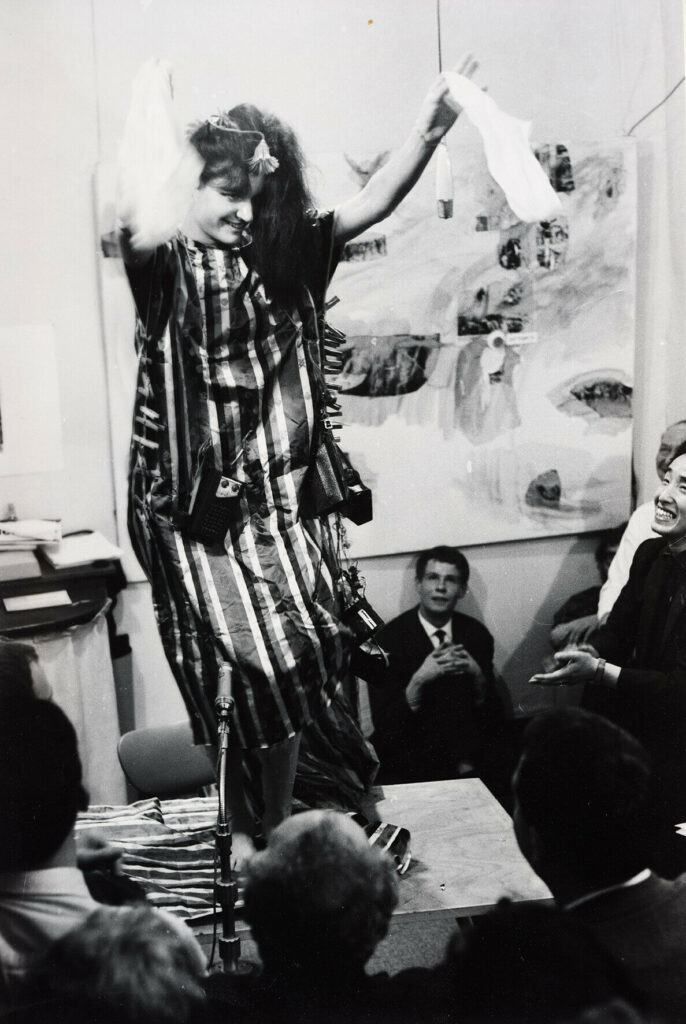
Serenade for Alison 1962
Performer Alison Knowles
Kunsthandel Monet Amsterdam 5 October 1962
Photo Hans de Boer
© Staatsgalerie Stuttgart, Archiv Sohm, acquired 1990
The Fluxus Immersion Bath
By presenting VR and minimal music as two well-paved roads towards immersive experience, we stray far from where it all began, both in the history of video art and, certainly, in that of minimal music. To remain with the latter, we return to 1959, when La Monte Young attended a summer course in Darmstadt with Karlheinz Stockhausen and there learned more about John Cage. He heard David Tudor perform Cage’s piano works, and later even gave Stockhausen a lift to Fluxus. Had Nam June Paik, pioneer of video art whose thesis concerned Arnold Schoenberg’s twelve-tone system, not performed his music, he might not have achieved recognition so swiftly. Young met Riley in Berkeley and encountered Cage in person. Thanks to the hospitality of Toshi Ichiyanagi and Yoko Ono, who maintained a studio in New York, they came into contact with many like-minded artists. (A detail: Ichiyanagi gave the first New York performance of Riley’s work.) Thus, around 1960, the cradle of ‘minimal music in the broadest sense’ lay in Darmstadt and New York. In September 1962, most of them gathered in Wiesbaden, and a few weeks later several were in Amsterdam. American students of Cage, an equal number of German composers and artists, and several Japanese artists began presenting their work through Fluxus events. The Lithuanian artist George Maciunas laid the foundations for the movement. These artists began performing each other’s work.
In Amsterdam this occurred at Kunsthandel Monet, regarded by the Fluxus artists themselves as the first international Fluxus event, since earlier events—such as Fluxus: Internationale Festspiele Neuester Musik—had taken place in Germany. Paik performed Young’s Composition 1960 #4 (1960), in which the audience determined how long the lights, once extinguished, would remain off. Paik’s Serenade for Alison (1962) was entrusted to Alison Knowles. Its instruments consisted of transistor radios, tapes, clocks and chance, constructing a kind of soundscape. Also on the programme were György Ligeti’s minimalist Trois Bagatelles, pour David Tudor (1961). The relationship between maker, performer and audience was fundamentally altered. Fluxus embodied an aesthetics of negation, the dismantling of barriers between artistic disciplines, and an anti-art stance with Dadaist overtones. Crucial here, however, is another aspect: the elevation of experiences considered banal, from the perspective of high art. A telling example is Riley’s Ear Piece, performed on multiple occasions, in which the audience was instructed on paper to crumple a sheet of paper before the ear and listen. Here we see the essential return to basic elements and experiences—to simple actions reinforced through repetition and concentrated attention. In these Fluxus concepts and scores we find much of what later culminated in minimal art and music, yet which conflicts with today’s dominant notion of immersive experience as a sublime, individual phenomenon.
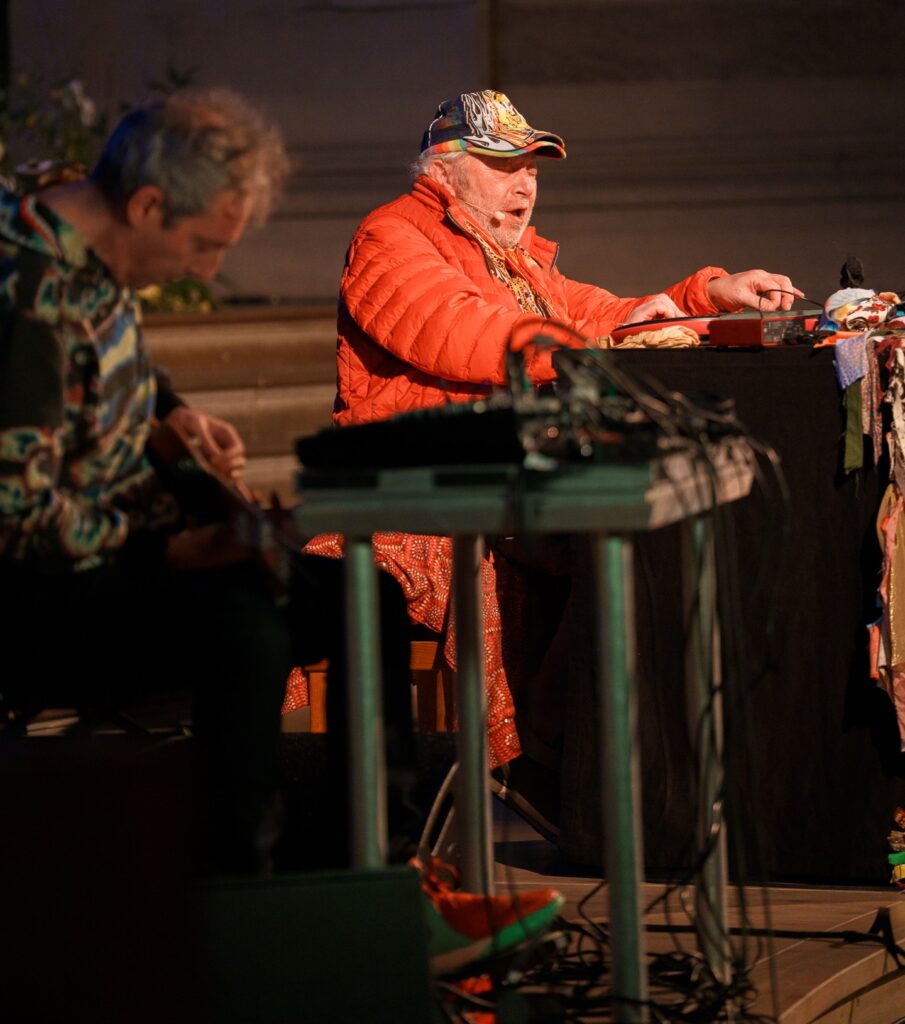
Performance with Oren Ambarchi and Daniel O’Sullivan
Karenina (KKAARREENNIINNAA) 1997-2025
Intonal Festival Malmö Sweden 23-27 April 2025
Photo: xx
Final Cord
While some visitors remained in Kunsthandel Monet on that evening in October, Paik’s Moving Theatre continued as a tour on the streets of Amsterdam: he dragged a German army helmet on a chain (Dragging Suite), while audience members sang personal pronouns in their own languages. At one point Paik set fire to a violin with a radio attached and threw it into the water. The only participating Dutch artist was Willem de Ridder, organiser of subsequent Fluxus events in the Netherlands.
Will traces of that Riley’s Ear Piece still be discernible in what is to be heard from him in April at the Muziekgebouw aan ’t IJ? It seems more likely that Charlemagne Palestine—who in the 1970s was often to be found at art space De Appel among fellow video artists and an occasional composer—will immerse his audience in what lies behind us.
P.S. See for a video of one of De Ridders’ most famous PK’s my blog on this website, called ‘The Pillar Stubs in the Media Landscape’.
- Not to be confused with the European Minimal Festival (1982-1987), set up by Michel Fahres, which was preceded by a survey of more than 1,000 composers, musicologists, and institutions, providing insight into ‘poor music’ worldwide, as reflected in the festival’s programming. ↩︎
- Akkemay Lammers, ‘De immersieve ervaring van video-installatiekunst. Een verkenning van het toeschouwerschap en aspecten die ten grondslag liggen aan de immersieve ervaring van video-installatiekunst,’ University of Amsterdam, May 4, 2016. The third case study involved installations by Melano Bonajo. ↩︎
- See Marga van Mechelen. Art at large: through performance and installation art. ArtEZ Press, 2013, pp. 166-193. ↩︎