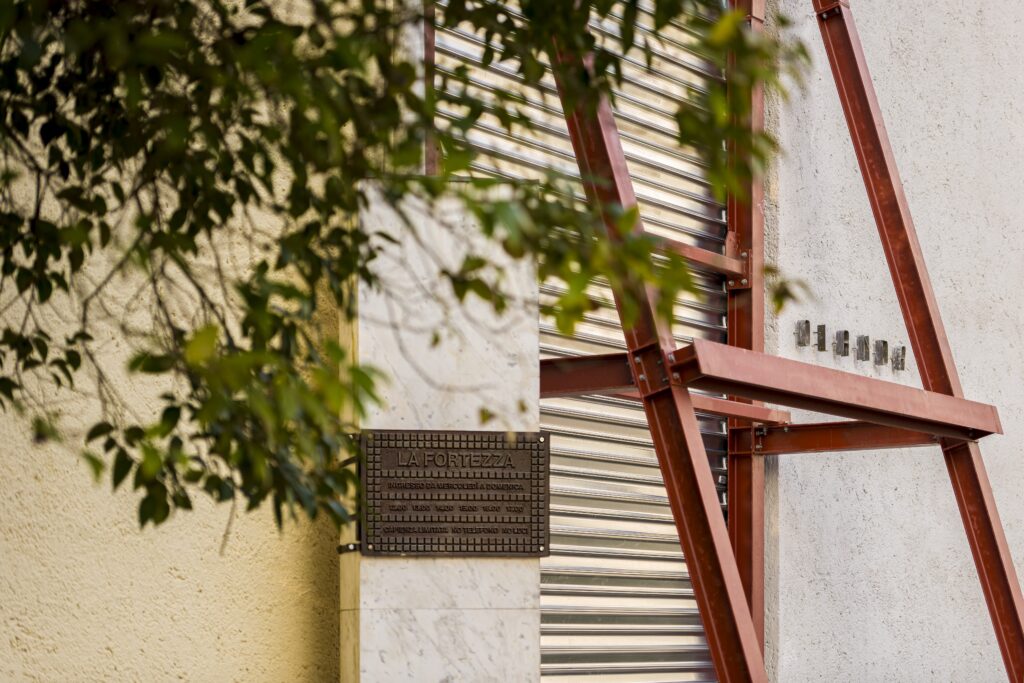
On Wednesday, March 31, artist Dries Verhoeven and curator Rieke Vos presented their plan for the Dutch contribution to the Venice Biennale in Theater Utrecht, a space Verhoeven clearly feels at home in. However varied his projects may have been, they’ve so far landed more comfortably in the world of theater than in the visual arts. On stage stood a model showing how the Dutch pavilion in the Gardini will be turned into a kind of fortress —though the interpretation is left open to “a fortress that needs to be kept from collapsing.” It brought to my mind the stately farmhouses in the province of Groningen that have to be propped up after years of earthquakes. Here, inside the pavilion, the cracks in the plaster will probably not be smoothed over. On stage in Utrecht, alongside the artist and the curator, were also two of the three authors of the accompanying publication, namely Bas Heijne en Maurits de Bruijn. They read excerpts from their essays, sketching out the broader cultural and political context of that other, more troubling world we shouldn’t look away from. The presented plan also entailed admitting about a hundred people to the pavilion at a time, four times a day, under the strict condition that they remain inside for 25 minutes. Besides the participating visitors, a few other theater performers will be present too, but, as the artist and curator emphasized, don’t forget the performance of the building itself.
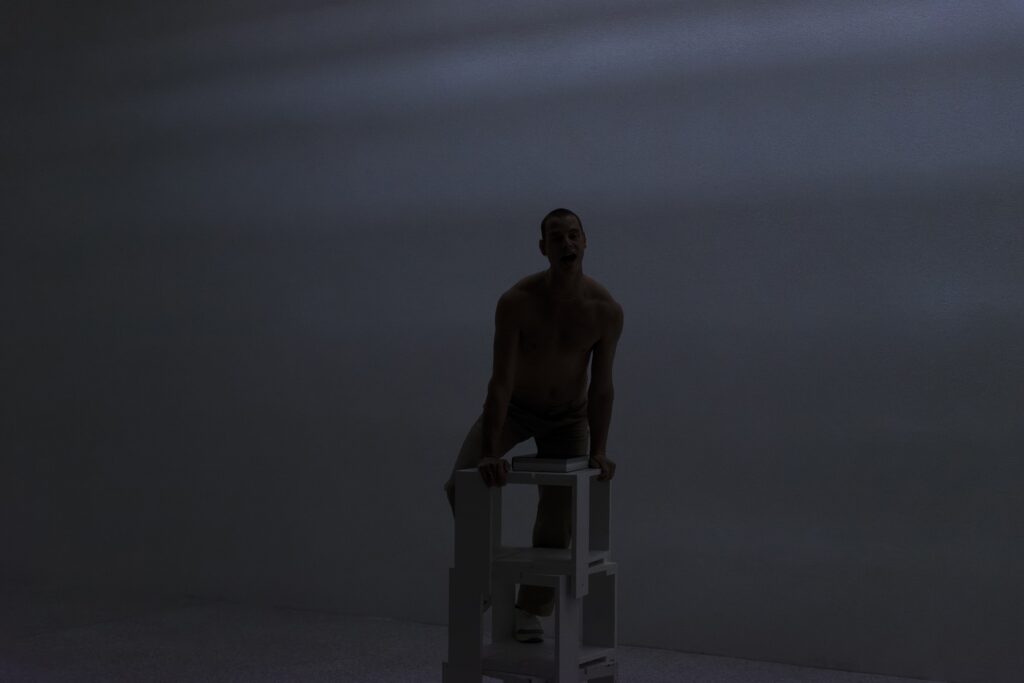
What stood out to me in Verhoeven’s explanation was the repeated use of the term “symbolic space.” It’s something exhibition spaces and theaters have in common—each with its own kind of doorbell policy. Nothing unusual, really—until it’s emphasized. That’s when you sense something is up. To reassure future visitors: you’ll come out just fine. Still, it will feel different from walking into a gallery or a theater. You’re stepping into the world of performance—and into its slightly paradoxical, often uneasy doorbell policy. Back in the 1970s, if you wanted to see what was going on behind the doors of for example the Amsterdam Foundation De Appel —the first center dedicated to performance art—you had to ring the bell, like entering a sex club.[i] Once inside, you’d be served a cup of jasmine tea, or were led to the performance space. Except on that infamous day, March 29, 1978, when the staff was gone —as it later turned out they had been kidnapped by the team of the German artist Mike Hentz. It was a deeply unsettling experience for the participants, but just as much for the management, who later tried to erase the event from the institution’s history.[ii] Less dramatic was the way Albert van der Weide had taken over the reins including the doorbell policy a few months earlier. The anteroom had been transformed into a front room with a fluttering white curtain beneath which lay black-and-white photographs of South Africa from that era, pointing the way to the performance space. There, the artist welcomed his audience with an outstretched hand; a wet, black-painted hand. After every interaction, he repainted his hand, but many visitors avoided it. It is a work with an unambiguous message, yet one that is nonetheless embarrassing. For the call for connection—’solidarity’ was the keyword at the time—you paid a price: getting your hands dirty. There had been shocking performances before, and there would be more to come—but artists became more cautious. Curators and institutions too.
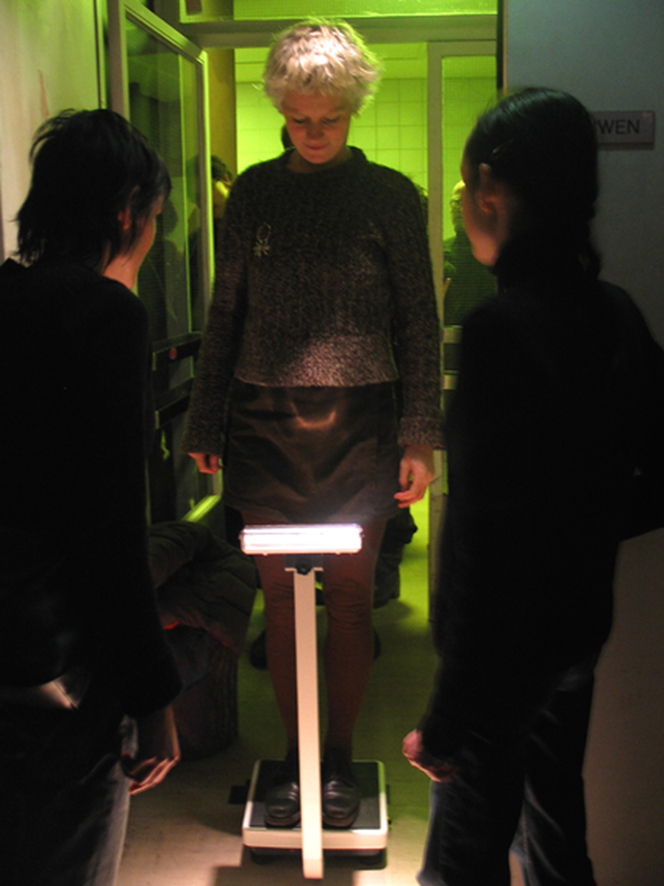
In 1996, when Marina Abramović had a major exhibition at the Groninger Museum, visitors had to sign a contract to attend a private-made film screening—even though they had already passed the “symbolic doorbell” of showing the entrance ticket. Around that time, and in the decade that followed, reenactments of performances started to gain traction. Younger performance artists often gravitated towards the more confrontational works from performance art history. One such piece took place at Post CS in Amsterdam in 2004. As I wrote at the time, the audience walked straight into a trap set by a well-known Dutch artist duo, L.A. Raeven.[iii] It reminded of Imponderabilia by Marina Abramović and Ulay. One by one, people allowed themselves to be weighed by two silent figures, the artists, unaware that a camera was projecting both the act and the revealing numbers of their weight onto twelve large white screens. Each person, who had just briefly been the exposed star of the show, left the playground by walking along a red carpet, while the artists applauded, and disappeared back into semi-darkness and became unavoidably the voyeur of the next victim. Light and darkness await Verhoeven’s performance participants too, though in quite a different atmosphere.
Elsewhere in Venice, at the Gallerie dell’ Academia, from May 6 until October 19, one can see Abramovic’s own re-enactments of Imponderabilia (1977) and Light/Dark (1977), along with other early performances.
[i] The (first) international erotic film festival Wet Dreams that took place in Amsterdam in 1970 stipulated that every visitor, usually also a participant, had to be a member, as if it were a society. This ensured that it remained within the boundaries of what was legally permitted.
[ii] For my monographe on De Appel (de Appel. Performances, installations, video, projects 1975-1983, Amsterdam: De Appel 2008), I have decided to include a description of the proceedings and photographic documentation with the cooperation of Mike Hentz (p. 192-193).
[iii] https://www.mediamatic.net/en/page/13049/de-prikklok-gezet