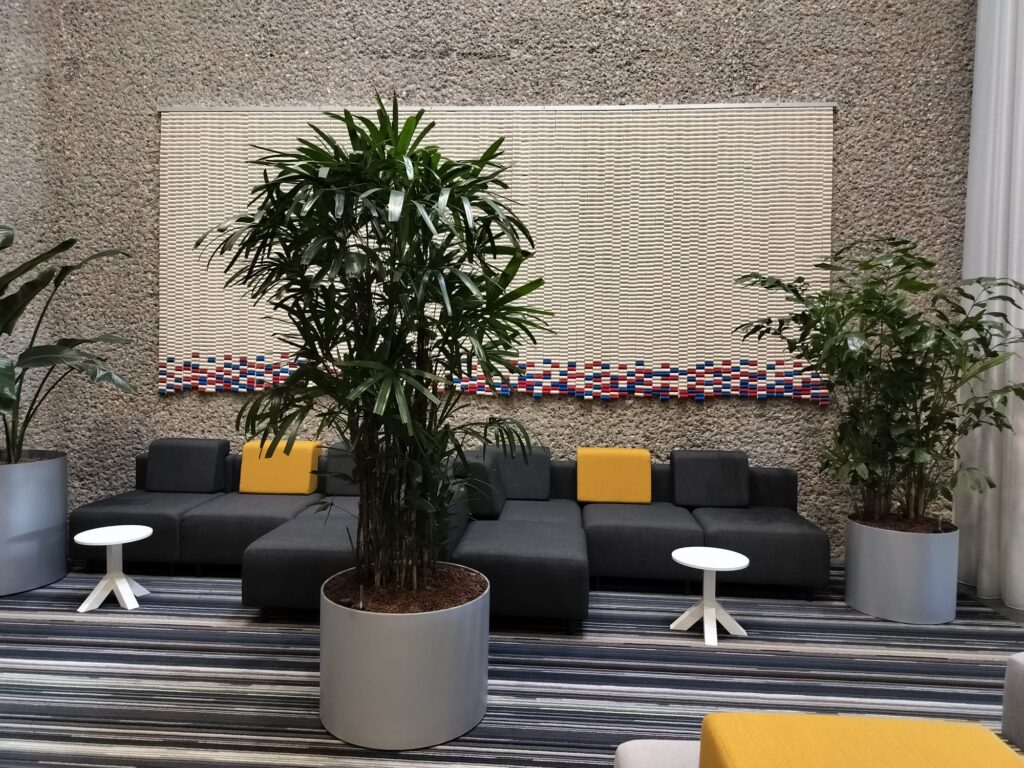
Tapestry in the background Composition by Madeleine Bosscher (1942)
Art with a Capital A—that’s how the Province of North Brabant regards its art collection, which received special attention last summer thanks to exhibitions devoted to the Polish artist Magdalena Abakanowicz (1930–2017) at the Textile Museum in Tilburg and in ’s-Hertogenbosch. The largest work in the provincial collection is by her, aptly titled Bois le Duc: “a whimsical, enigmatic, dense forest with protrusions, fissures, and mysterious passages.”[1] Most of her works are executed in textile materials and on a monumental scale. Yet given the history of the collection, the capital “A” can also be read in another way.
Much of the collection dates from the completion of the provincial government building in 1971, designed by Hugh Aart Maaskant (1907-1977) — one of the most significant postwar architects in the Netherlands and creator of the Groothandelsgebouw in Rotterdam. Just three years earlier, in another of his buildings, Katshoek (also in Rotterdam and then still under construction), the leading Dutch Constructivists (konstruktieven) were invited to transform building materials into temporary objects, briefly on view in the unfinished structure. These were indisputably artists with a capital A, at a moment when textile art in the Netherlands was still largely regarded as a minor art form. Thanks to initiatives such as the Textile Triennial in Haarlem and Abakanowicz’s solo exhibition at the Stedelijk Museum in Amsterdam, both in 1968, that perception slowly began to change. Still, subsequent textile exhibitions at the Stedelijk remained firmly under the auspices of the Applied Arts department.
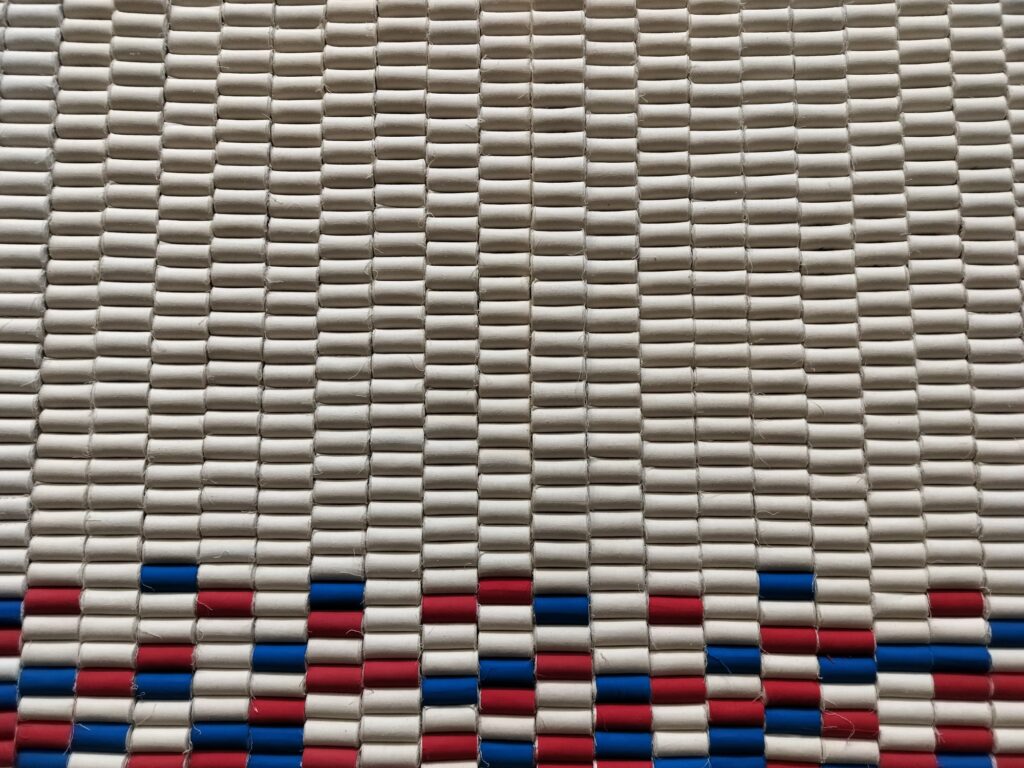
Maaskant and Jean Leering, director of the Van Abbemuseum—who had presented Abakanowicz’s work in Eindhoven some years earlier—were both members of the Commission for Art Applications and Acquisitions. Their vision extended beyond the Netherlands, towards the Lausanne Biennale, where “pioneer in Textile Art” Wil Fruytier (1915-2007) had already participated three times before 1971. The collection the two men assembled includes works by her as well as by a.o. Madeleine Bosscher, Ria van Eyk, Krijn Giezen, and Herman Scholten. At first glance, these works appear remarkably well preserved, and for many visitors who initially came to see Abakanowicz, they turned out to be the great revelation of their visit.
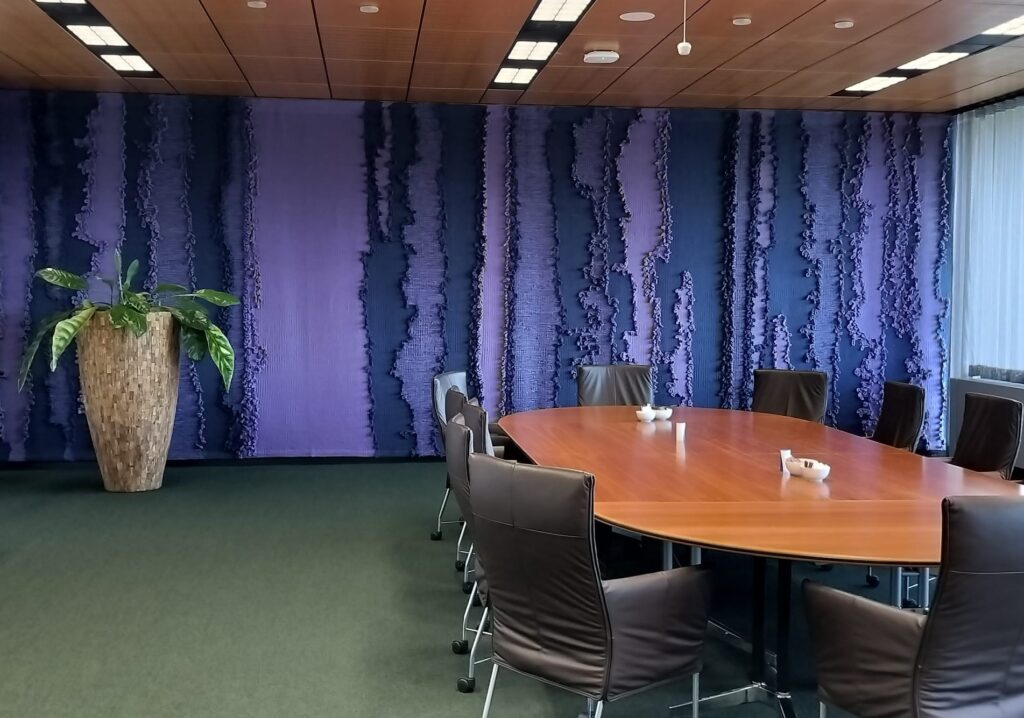
Tapistry in the background Composition in purple by Ria van Eyk (1938)
Yet work remains to be done. While I am less bothered than my partner by trees that obstruct views of fine architecture, I would welcome the removal of the houseplants. I do not think they still serve the educational role that Willem Sandberg envisioned when he introduced the houseplant to the Stedelijk Museum in Amsterdam, as a touch of nature as well. It even grew into a collection of thirty different species.[2] Of course they block the view, but more importantly, they also obscure a meaningful history—the late yet decisive emancipation of textile art in the Western world, which gained momentum during the 1960s. “I want art not decoration in my building” said Maaskant. The art committee at the time deliberately chose not to focus on applied art, nor to pursue stylistic uniformity or a single movement, as had been the case in Katshoek. Instead, they selected works that could hold their own within the vast spaces of the provincial building—works distinguished by scale, visual impact, and conceptual strength.
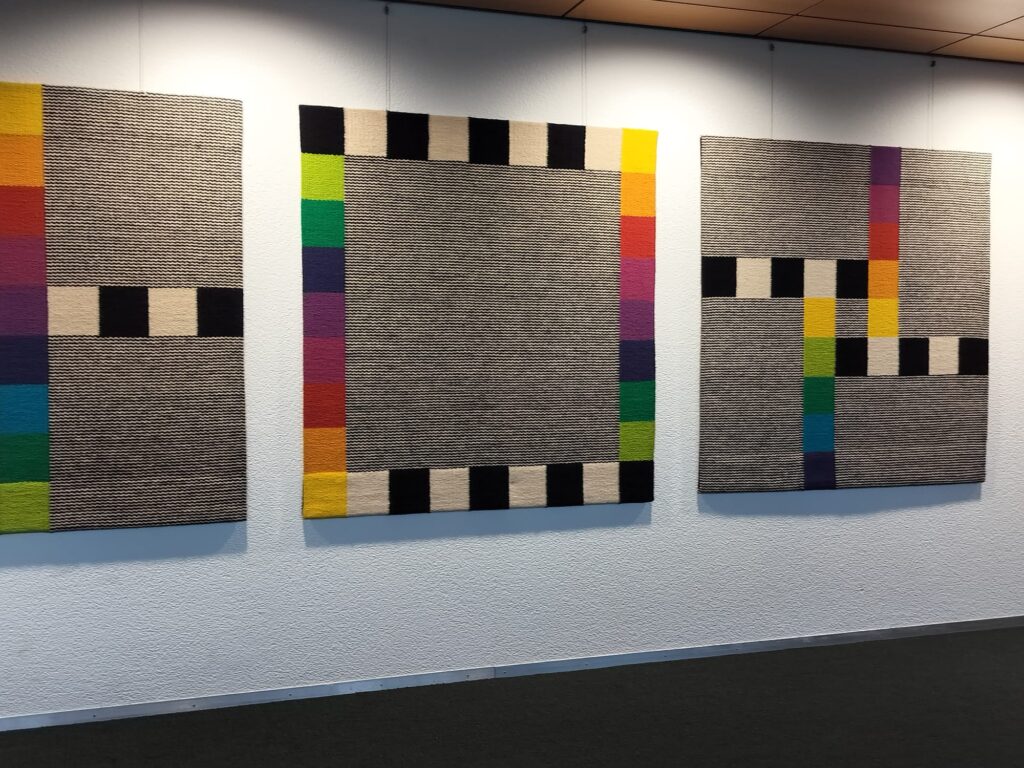
Ria van Eyk (1938) Composition (1971)
And for those who might dismiss the practice of placing plants beside artworks as provincial: a recent visit to Argos, the progressive cultural center in Brussels, showed me otherwise. There the irresistible Belgian fondness for the sansevieria apparently could not be resisted. (As a side note: the very last plant to leave the Stedelijk Museum was, fittingly, a sansevieria too!)
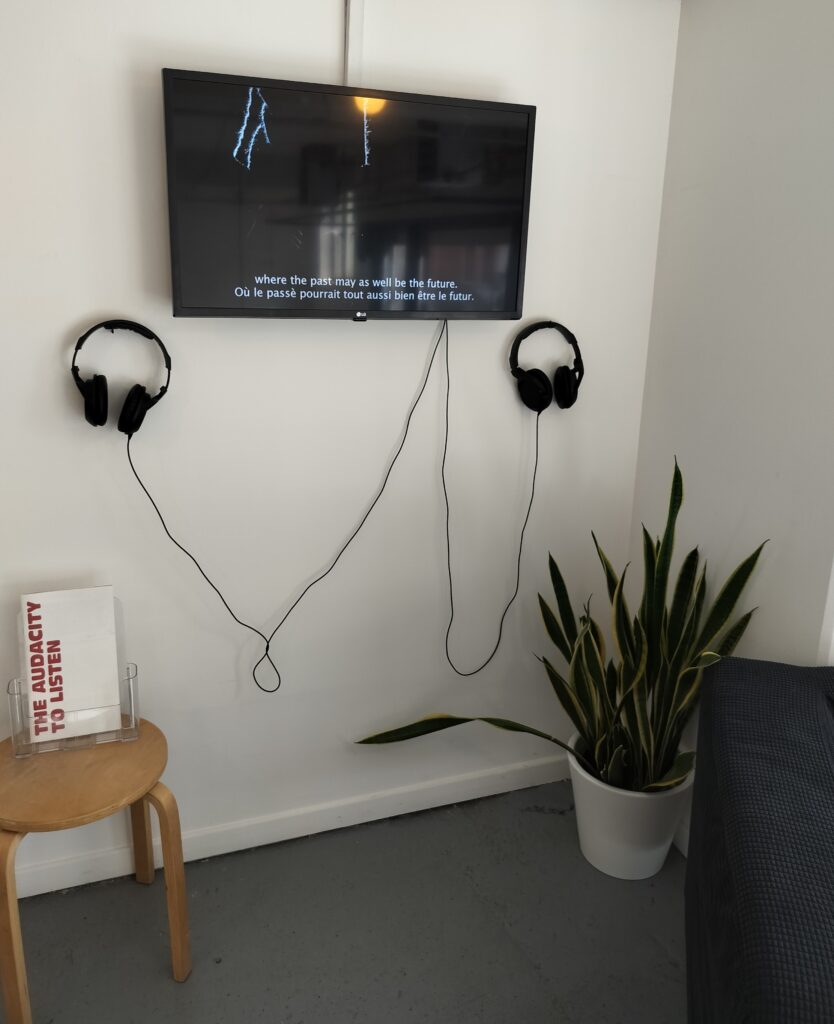
Argos Brussel
[1] https://www.bossche-encyclopedie.nl/literatuur/kunstcollectie%20provinciehuis.pdf.
[2] See Inge Meijer, The Plant Collection, Amsterdam: Roma Publications 2019.