
(realisation Kröller-Müller Museum Otterlo 2021; photo Marjon Gemmeke)
In the Volkskrant newspaper of January 21, following a tumultuous week at the World Economic Forum in Davos, Sander Schimmelpenninck gives the media a cold shower in his column to cool them down from their euphoria about the former prime minister of the Netherlands, now NATO chief, Mark Rutte. He speaks of ‘chauvinistic folklore’ as we know it from soccer journalists who are all too eager to show how excited they are about the praise for Dutch footballers in the foreign press. Something similar crossed my mind when I heard the first reactions to Jan Dibbets’ exhibition at the H’ART museum that opened last week. He is presented as a prophet in Dutch art who was not sufficiently honoured by his own fellow countrymen, but all the more so by the better educated and more culture-loving French. A view in which the critical reader is strengthened by how Museum H’ART announces the exhibition. And also what it possibly implies. We read: ‘It is the first monographic presentation dedicated to Jan Dibbets (1941) in Amsterdam since his exhibition at the Stedelijk Museum in 1972.’ ‘The exhibition looks back on a crucial period in the artist’s oeuvre in which he gave up painting for photography.’ The crucial period is 1966 to 1976; the focus a break in his development. Given the commotion surrounding the Erwin Olaf exhibition in the Stedelijk Museum and the disrespectful attitude towards him by the museum in the past, this introduction can hardly be read as neutral anymore. Why not ‘first monographic museum presentation’? It may seem like nitpicking, but this would have been more accurate, because in this period alone he had five solo exhibitions in Amsterdam, at the renowned Art & Project gallery. Considering his international position at that time, he could certainly have been on the list of a Quote 10, if it had existed. What matters here is the question if is it interesting at all to point to other countries to elevate Dutch luminaries, whether they come from politics, sports, or the arts? My answer is: Not if it is used as the easiest way to capture the public’s attention or to highlight the cultural barbarism of the Dutch. But it might be interesting if it increases insight, here into the art and development of Dibbets.

(realisation Kröller-Müller Museum Otterlo 2021; photo Marjon Gemmeke)
There is one source, itself a collection of sources, that is very helpful to trace the development of Dibbets’ work in the period from 1966 to 1972, namely Lucy Lippard’s The Six Years. The dematerialization of the art object from 1966 to 1972, ‘a cross-reference book of information (…) focused on so-called conceptual or information or idea art (…) in the Americas, Europe, England, Australia, and Asia’ (text on the cover of the book). What I only recently noticed in the long entry is that England is separated from Europe. Rightly so, as it did not belong to the European Union yet. Now that we don’t have to count Dibbets’ London-based study friend Richard Long, the Dutch artist is the most frequently cited European artist in the book, which is not so surprising as his work fitted into all the categories covered. In line with the above, it should be noted that France did not play any significant role in the earliest stage of his career. His public fame in France dates from shortly before 2000 and is the direct result of two major commissions he received in France in the mid-1990s: Hommage à Arago (1994), a series of 135 bronze medallions marking the historic meridian through Paris, and the 32 stained-glass windows for the cathedral of Bois, a commission awarded to him in 1992 by Mayor Jack Lang (formerly the renowned Minister of Culture) and for which he received the Sikkens Prize in the Netherlands in 1995; it was based on the designs only as the windows were not ready yet. While the artistic circle covered by Lippard’s book was too small and too specialized to achieve fame in the United States during that period, the US were nonetheless of unprecedented importance for his career. He had the most exhibitions there, and those exhibitions still live on in art history textbooks. The Netherlands and Germany came in second and third place, or maybe the other way round.

Three years before the year Lippard’s book begins with, Dibbets had already presented himself as ‘the ‘dematerialiser’. Though he only said a final farewell to painting four years later. In March 1970, Lippard invites him to a symposium in New York, where she asks him for an explanation of one of his early works, dating from the time when he made many, often ludic interventions. It is entitled Robin Redbreast’s Territory Sculpture, and had been on display a year earlier in the group exhibition ‘Ecologicial Art’ (May/June 1969) at the John Gibson Gallery.1 By placing new perches for robins in a park and thus influencing their behaviour, it seemed that he had intervened in nature and an ecosystem. He is not particularly inclined to elaborate, and his response to the next question is also brief, but spot on. It is about his newer work, the perspective corrections, the essence of which she summarises as ‘a replacement of the seen perspective with the photographed perspective.’ When she asks: ‘Did the works themselves have any importance to you or just the photographs?’, his answer is: ‘the photo negatives’ (p. 159). That is to say, in my words: the visual information of the negative and not the (countless) performances of it. From Lippard’s book we can deduce that he had already gained some fame, that only increased after its publication in 1973, a year after Dibbets’ solo exhibition in the Dutch Pavilion at the Venice Biennale. It is noticeable that his views have changed somewhat in the intervening years.2 His presentation in Venice made clear that he became more concerned with showing the process.
(realisation Kröller-Müller Museum Otterlo 2021; photo Marjon Gemmeke)
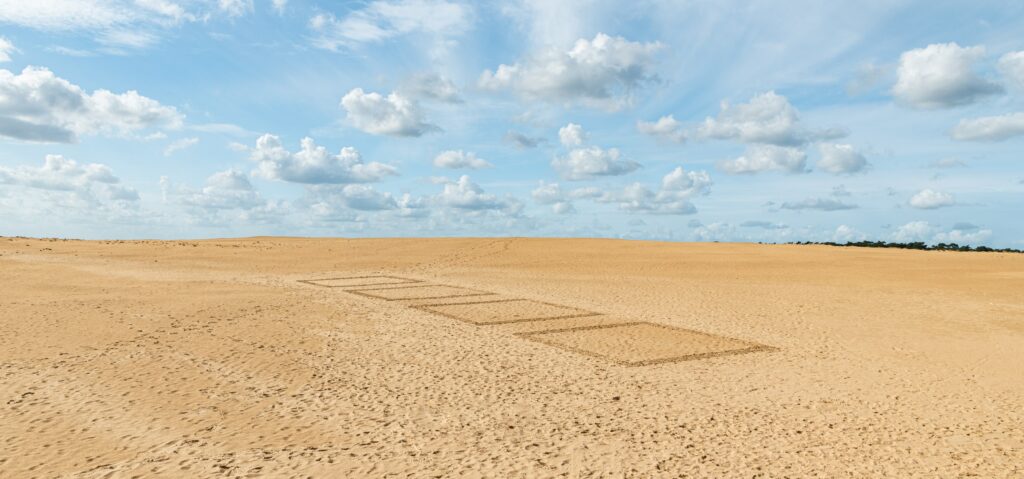
Following the Venice Biennale, he had a major exhibition in the Stedelijk Museum in Amsterdam. On that occasion director Edy de Wilde briefly outlined the steps Dibbets took away from painting. Which were they? Generally his interventions in nature are mentioned first, where photography was only used as a means of recording. An further example is the Ploeg [plough] project (1967) in the province of Groningen which was signed by the name of an institute, the International Institute for the Retraining of Artists, and realized at the invitation of gentleman farmer and gallery owner Albert Waalkens.3 In the arable land of Finsterwolde, Dibbets, Ger van Elk and Reinier Lucassen, all founders and teachers at the institute, drew a form into which they poured polyurethane. The solidified shapes, which were yellow-brown in colour, they painted red, white, blue, orange (the colours of the Dutch monarchy) and green and then neatly glued them together. Five drawings, called Constructions in the landscape, date from the same and the following year, but were hardly known until 2021. They are credited solely to Dibbets and were intended to be executed, but this never happened. After the purchase by the Kröller Müller Museum of one of the drawings, and the donation by the artist of the remaining four to the museum, it was decided in 2021 to execute them. Construction 2 grass rolls (1967) and Meadow Piece (1968) were eventually executed in the sculpture garden of the museum and Raked sand (1968) in the adjacent National Park De Hoge Veluwe. In addition to the photographs of Long’s constructions in the landscape, they also remind us of the last and most famous photograph of Oppenheim’s 1969 land art project Directed Seeding-Cancelled Crop. Here we see from the air a Groningen wheat field of almost three hectares through which an agricultural tractor has drawn a cross during harvest. Only to realize that the last event and the photos that have remained, were from a later date than Dibbets’ constructions. While Long’s and Oppenheim’s use of photography still was essentially to document a situation, Dibbets was working on quite a different track, namely of correcting the linear perspective that had determined traditional painting for centuries, but also testing human perception in general. Under the same umbrella as Oppenheim’s project, namely the exhibition Op losse schroeven (1969) at the Stedelijk Museum, a solo action by Dibbets took place around the museum: he exposed its foundation by digging a hole at each of the four corners. It is unlikely that he will do the same with H’ART, in the former Hermitage Museum of Amsterdam.
- Seth Siegelaub published the documentation of the project in the form of an artist book a year later. Lippard published on pages 138-139 a description of the project. ↩︎
- In later years, Dibbets distanced himself from what he saw as a pseudo-scientific image that conceptual artists presented of themselves. ↩︎
- See for the early radical years of conceptual art and the interest in the relation of art and nature, with more about Jan Dibbets’s role in it, my forthcoming book about Dutch art in the sixties ↩︎
Great blog! Dibbets had indeed some solo shows, but his work was shown very often in collection presentations!