Part II
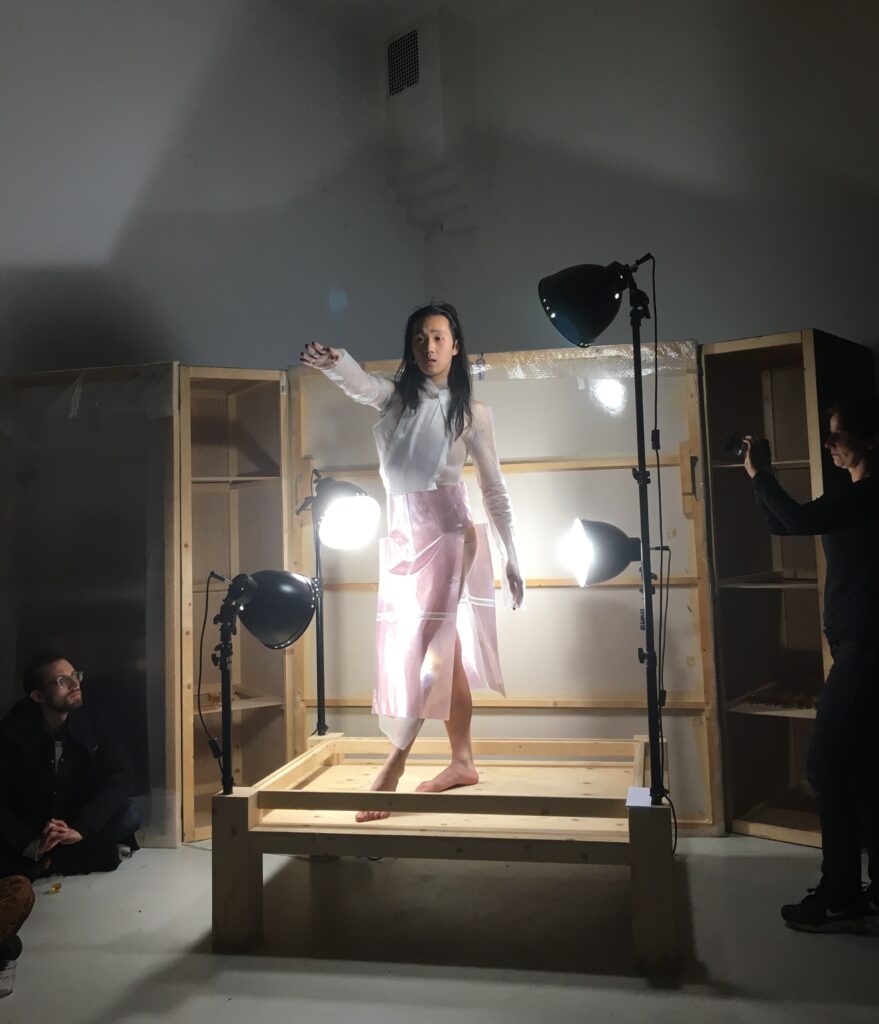
Photo: Ting Gong (clothing from his collection)
On my way back from Paris and Disneyland, I visited the MUDAM (Museum of Modern Art) in Luxembourg, on the third of May, where I encountered a blissful Sunday calm. I had come for the exhibitions of Ivan Cheng and Simon Fujiwara.1 Not well prepared, I stepped to my surprise into Fujiwara’s “worlds of wonder”, in an exhibition called A Whole New World. Tempting as it was to linger in his theme park with Aladdin’s sweet voice in my ears, I nevertheless gave priority to Cheng, whose performance I had once seen in Amsterdam, the city where he still lives. That performance had taken place to mark the launch of Michael Gibbs – let it keep secrets to which I had contributed. It was hardly surprising that Gonggrijp chose Cheng, whom she knew from a spoken-word performance, in honor of her late partner, known as a performer and visual poet in the Fluxus tradition. At the time Cheng was an unknown performer to me, and in truth he still is. Yet I recognized something of that stunning 2016 performance in what I now saw at the MUDAM. Once again I was fascinated by the ‘magic’ of this multitalented artist.
Courtesy the artist and Edouard Montassut
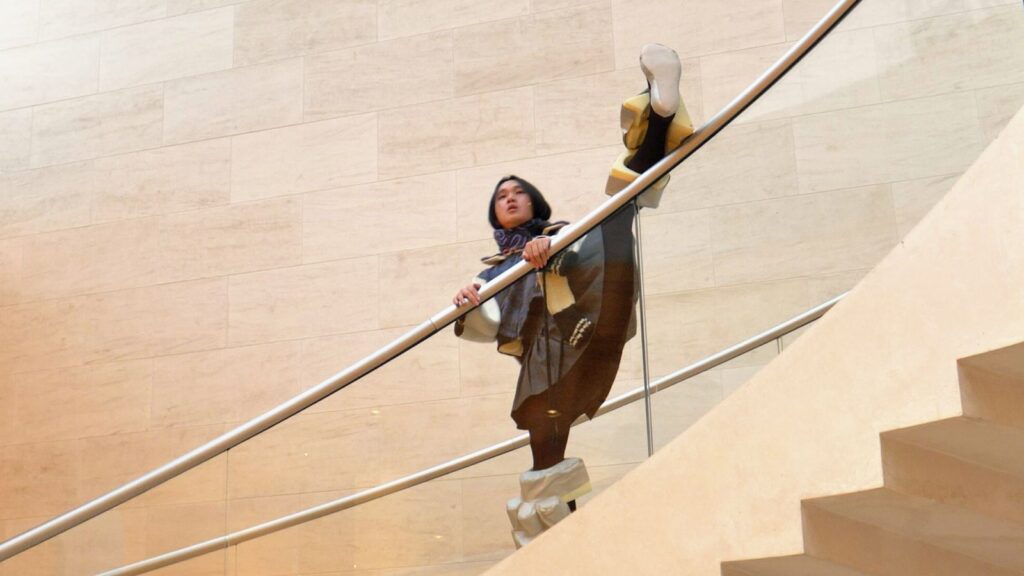
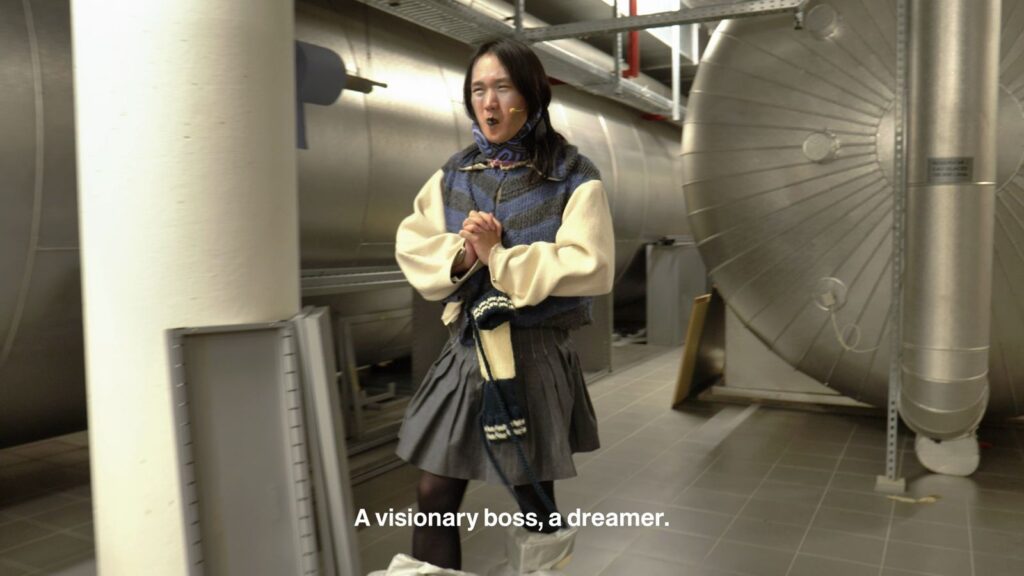
The day before, I had read the text on performance art written by de Volkskrant journalist Alex Burghoorn for a supplement in the newspaper entitled Art to Experience. The immediate reason was Dries Verhoeven’s entry for the Venice Biennale, entitled The Fortress, and the accompanying performance program, for which he converted the pavilion into an impregnable fortress (see blog 13). I had enjoyed the way Burghoorn interwove histories of performance art from the 1970s to the present, even though in my own publications on performance art I tend to emphasize ruptures within traditions rather than influence, continuity and connection in the proper sense. Cheng’s performances would fit well within my own approach, but that was secondary for the moment. What immediately triggered in the film The Boss (Fortress) that opened the exhibition was the question: “Who is he addressing, and how?” and “What role does language play in it?”
Courtesy the artist and Edouard Montassut
Unburdened by theatrical conventions, performance artists in the past generally seemed to pay little attention to their audience, immersing themselves mainly in their own actions. How different it is with Cheng. In a torrent of words, he continually addresses the viewer directly throughout the film, without interruption, filmed by a camera that follows him as though he himself were steering it, as if he were standing in selfie mode—a familiar image today because of the way influencers speek to their audiences, though without their simplistic messages or merchandise. What also stood out was how he had appropriated succesfully I.M. Pei’s oversized and rather sterile ‘fortress’. The exhibition title, Casemates, refers to the military history of the museum’s location. Partly because of that I considered his tour through the museum as a conquering of the public spaces, and a penetration into its hidden depths, which resemble the engine room of a vast (space) ship. And then there was that torrent of words, which distinguishes this performance from the way language has often manifested itself in the history of performance art. I would not claim that language was previously unimportant, but most performers were people of few words. Yet there are performances remembered precisely because of their brief texts.
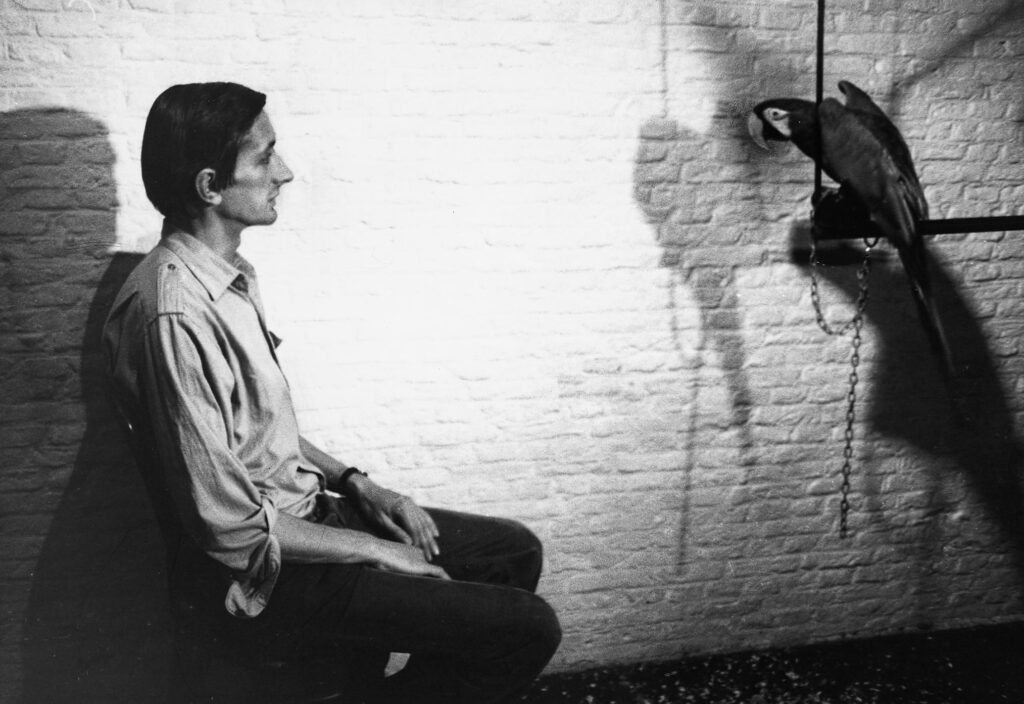
Photo: Thijs Schouten
Such as Parrot Training (1976) by the Hungarian-Dutch artist Nikolaus Urban, in which Urban spent eight days trying to teach the parrot Wittgenstein’s phrase, “Wovon man nicht sprechen kann, darüber muss man schweigen” (“Whereof one cannot speak, thereof one must remain silent”). Without success, incidentally. Another well-known apodictic phrase is that of Marina Abramović in the filmed performance Art Must Be Beautiful, Artist Must Be Beautiful (1975), words she repeated with increasing emphasis and emotion. And then, thirty years later, the performances of Tino Sehgal, which will forever remain associated with the phrase “This is so contemporary.”
In the reviews published so far of the performances directed by Verhoeven in Venice, particular attention has been paid to the words spoken by his performers—or rather, to the way they are spoken. Reviewer Anna van Leeuwen in de Volkskrant cites imperative phrases such as “Smile!”, “Love yourself!”, and the exclamation “You are great!” Reviews in NRC (Thomas van Huut) and Metropolis M (Domeniek Ruyters) mention phrases like “Stop it!” and “Rage!” These critics speak of “grunting,” presumably following curator Rieke Vos, described as “a speaking technique that is more physical than any other form of speech (…) The grunting must directly convey the stress that accompanies this speaking.”
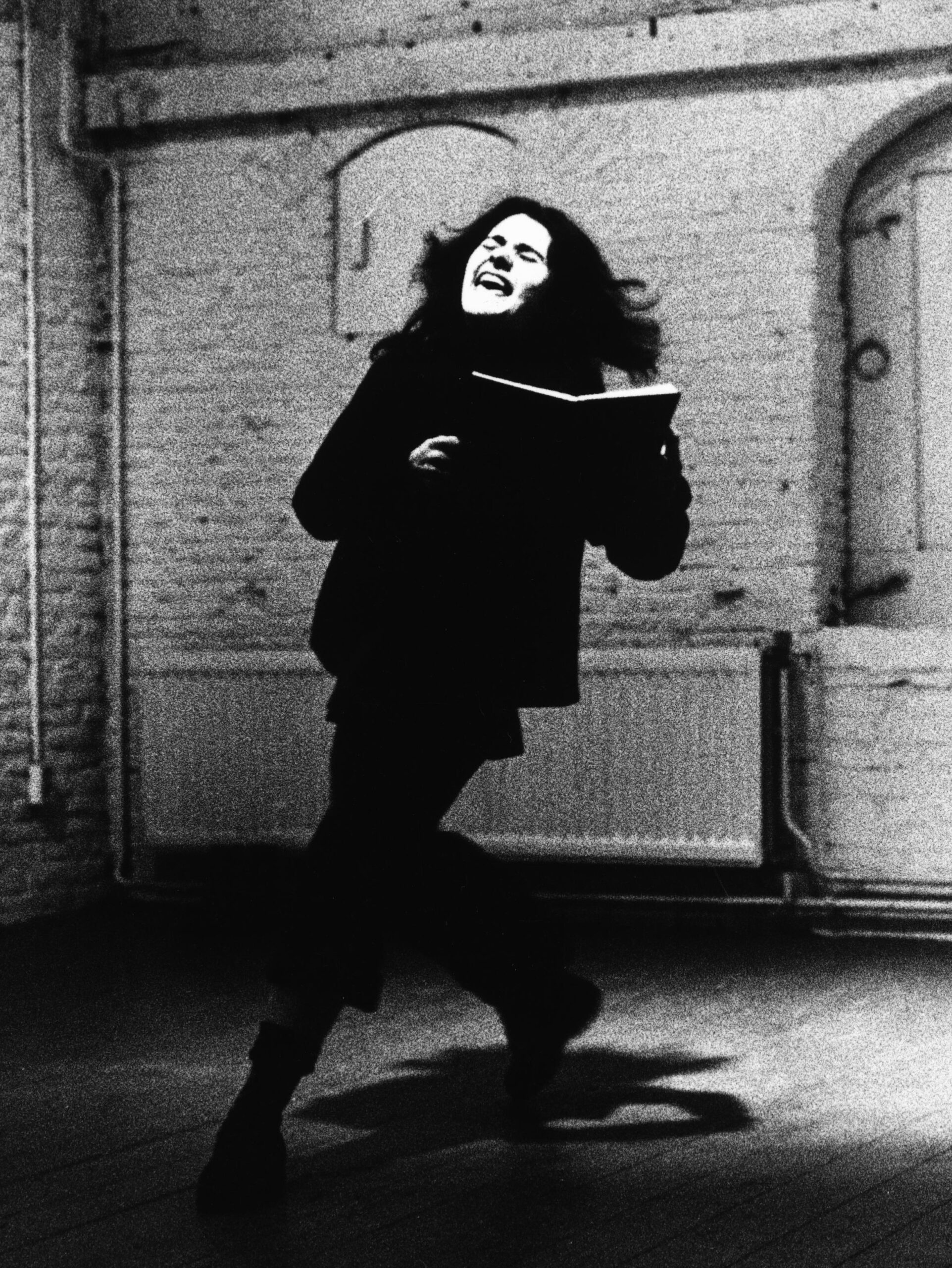
Photo: Thijs Schouten
I reminds me of Jana Haimsohn’s performance Ausdrucktanz of 1976, but also of other means to make the body audible in such a way that chills run down your spines. For example, the intense performances of the naked bodies of Marina Abramović and Ulay, such as Relation in Space (1976) and Expansion in Space (1977), where image and sound of the bodies functioned as equally powerful means.
What also stuck with me from Cheng’s previous performance in Amsterdam were his clothes and the choreography with which they were presented; that happened here too. You could say that everything, even the choice of ‘indifferent’ and timeless clothing – most common in performance art – communicates or expresses something. The meanings may vary: sometimes they refer directly and only to reality and serve as a means of identification, but often they are also symbolic. When the clothing is seductive or relates to gender issues, as in the case of for example Wally Stevens and Luigi Ontani in the 1970s, the choice of clothing was almost always more explicit, like with Cheng.
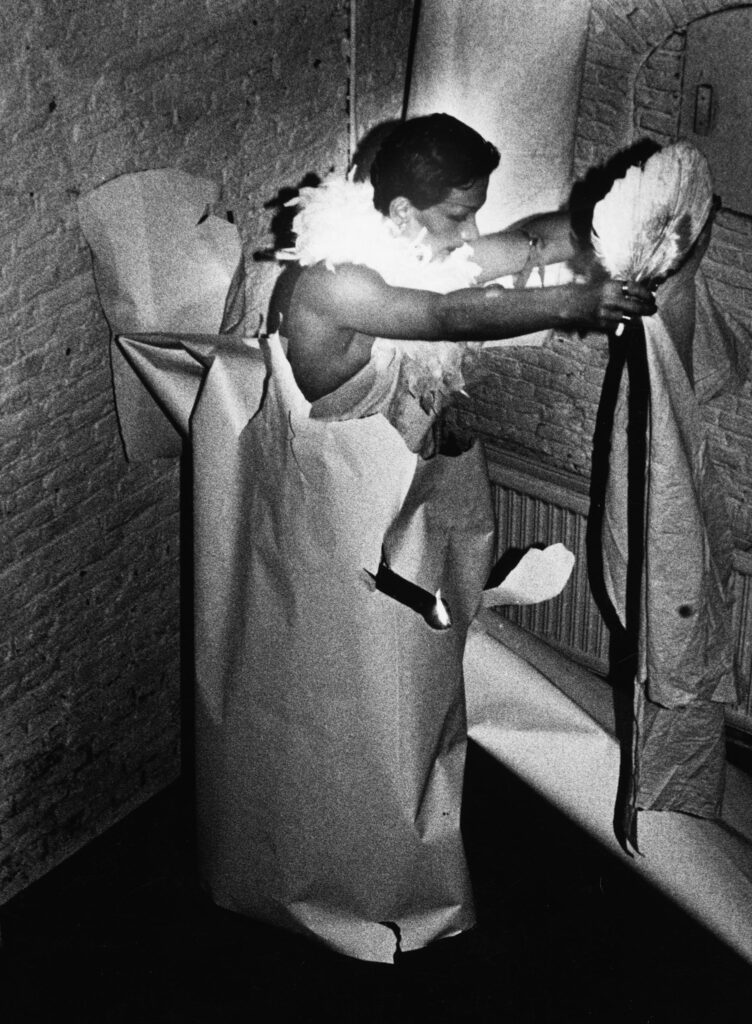
Photo: Thijs Schouten
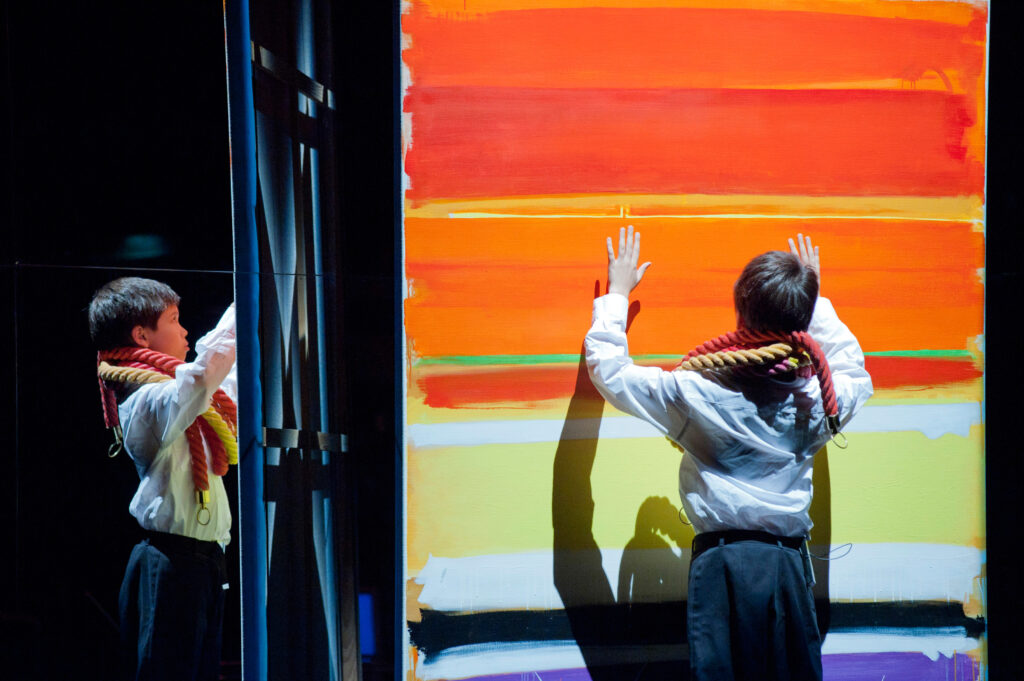
Although I remained under Cheng’s spell for a long time during my visit to the MUDAM, Fujiwara also demanded my attention elsewhere in the building with the film The Mirror Stage. It is a somewhat older project of his, known in several forms. In the film shown, he enters into conversation with a boy of multicultural background, almost the same age Fujiwara himself was when, some thirty years ago, he visited the new Tate St Ives museum and became deeply impressed by the abstract paintings of Patrick Heron. In fact, it concerns a sort of second mirror stage, a coming of age and precisely the moment when he first suspected his gayness while simultaneously realizing that art could shape his identity. The dialogue with the boy is a process of mutual acquaintance in service of a theatrical piece in the making. The boy has agreed to portray ‘him’, the artist, as a eleven-year-old. The tone is serious, yet the process of self-discovery remains light-footed. At the end of the film we see something of the result.
It is obvious that Cheng and Fujiwara leave the old history of performance art untouched and freely use—if not browse through—all possible formats, including low culture keys. In Venice, on the contrary, performance history is given every opportunity to shine. Here, both visitors and performers have the chance to show that they know and love their classics.
Copyright: Marcus Lieberenz/bildbuehne.de
In memory of Aggy Smeets, a member of staff at de Appel (1975-1983), who passed away on 11 May 2026.
- Both exhibitions have been curated by Léon Kruijswijk, who has been the performance curator at MUDAM since May 2005 ↩︎