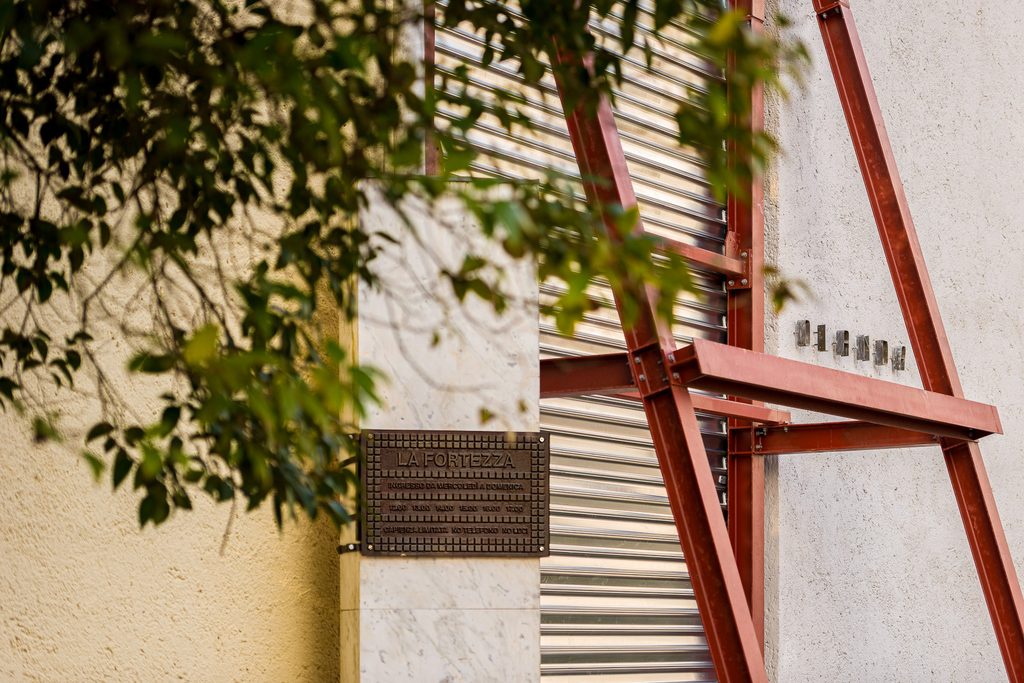
Photo: Willem Popelier.
In 1977, I attended the first-ever live satellite broadcast realised by an artist, a project that had emerged from years of collaboration between Sony and Nam June Paik. Although it was a private gathering, this demonstration of a technological breakthrough was the principal opening event of documenta 6 in Kassel. There I saw Charlotte Moorman perform wearing the TV Bra for Living Sculpture, designed by Nam June Paik: two small Sony television screens that covered her breasts. I was on a study trip. My tutor, Wim Beeren, a familiar figure in the international art world, had ushered us into the Sony pavilion.
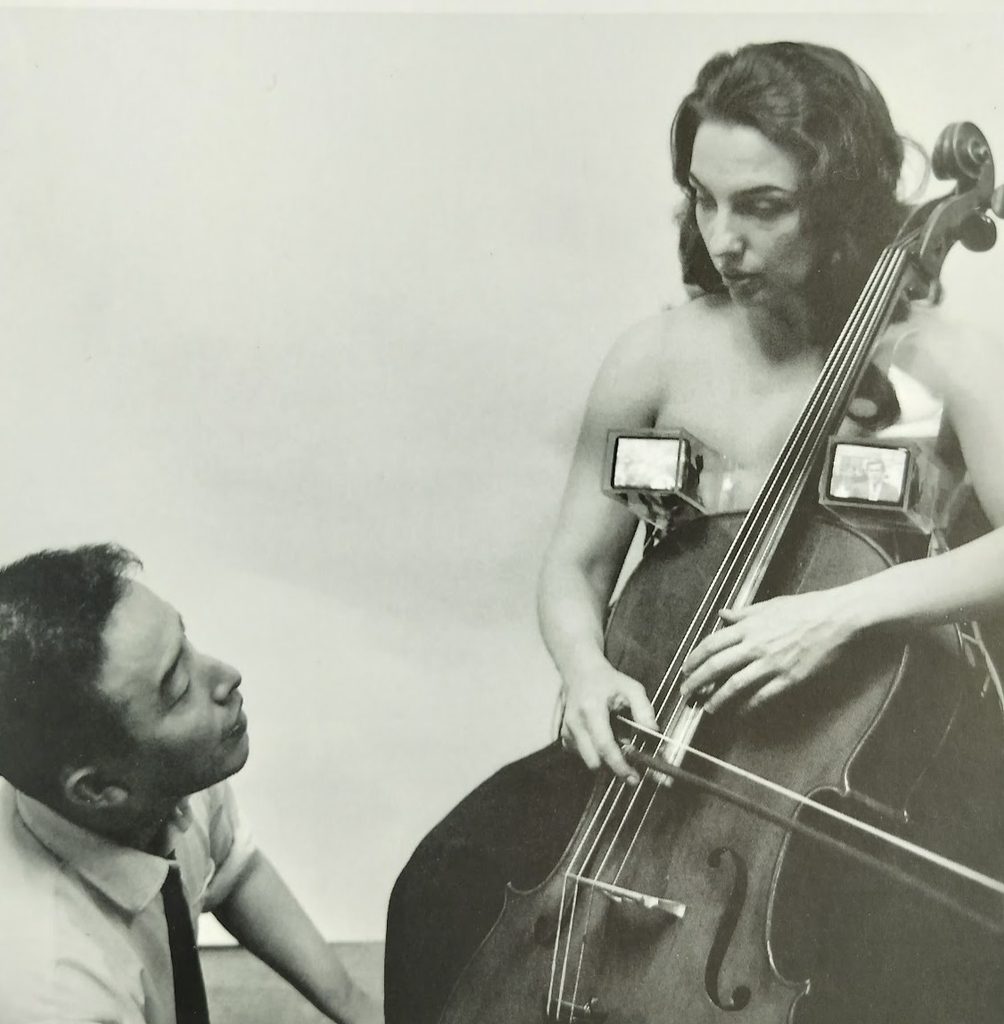
This edition of documenta was significant in its own right: more than any before it, or any that would follow, it was to be concerned with both performance and video art. In retrospect, one might conclude that Moorman and Paik’s performance did not directly correspond to what was on the programme that year. Rather, it anticipated the media-savvy, theatrical and multimedia performances that would become popular in the 1990s. During the following week, I tried not to miss a single performance and spent many hours among the videotapes in the attic of the Fridericianum. The programme included the Dutch artists Ben d’ Armagnac, Ulay and Marina Abramović (their homebase was Amsterdam). Our professor drew our attention to Joan Jonas: we were not to miss her. Thirty-eight years later, at the age of 78, she would shine in the American pavilion at the Venice Biennale. This year, I skipped the pavilion.
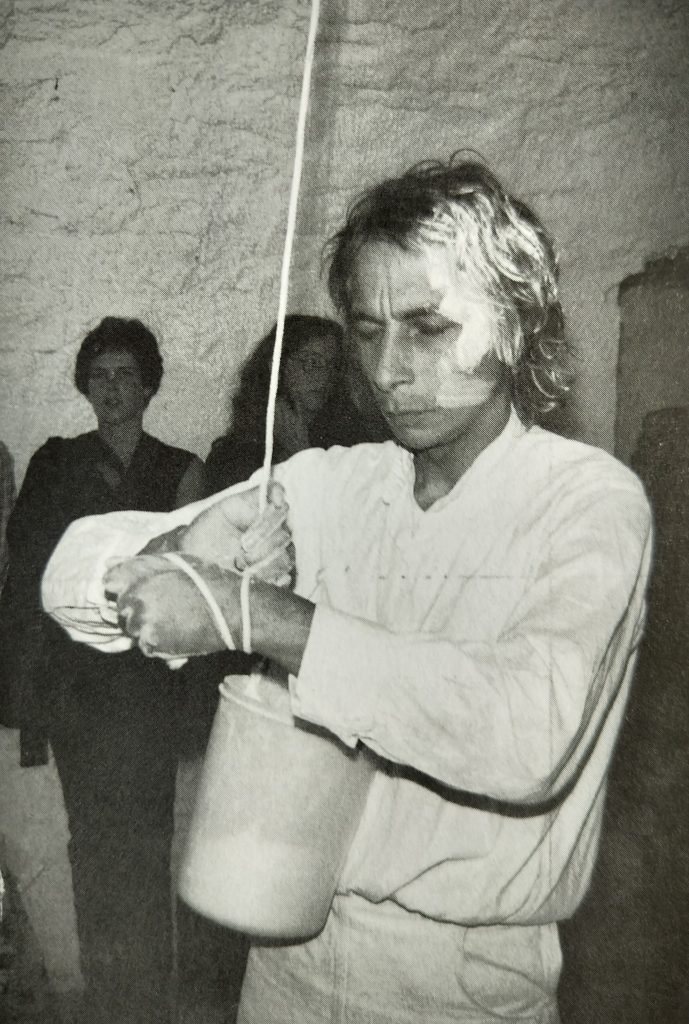
Photo: Elisabeth Jappe and Ralph Wernicke
D’ Armagnac stands within a circle of white chalk, with chalk in the bucket. Hanging from the rope, he begins to walk in an ever-widening circle; when he lets go of the rope, he kneels on the ground and draws a line with the chalk. He picks up the rope again and repeats these actions many times, with ever less control. With the bucket still clamped under his arm, the performance ends in a corner of the room among those present in the cramped space.
In the years that followed, Dutch performers appeared at documenta only occasionally. I recall Arno Arts, who in 1987 took part in documenta 8 live – Performance, Aktion, Ritual, a video project organised by Elisabeth Jappe, a renowned authority on performance art. Thirty years later, I saw Yaël Davids in the Neue Galerie, by then an established performance artist who had pursued her own path in the history of performance art. This year, the Netherlands has a prominent presence with a performance programme in its own pavilion, barricaded for the occasion, under the title Fortress. In the run-up to the Biennale, attention focused primarily on the political motivations behind Dries Verhoeven’s installation and performance programme, highlighted as well in the essays of the accompanying publication, and subsequently on his use of the vocal techniques known as growling and grunting. Photographs of the iron beams attached to the Rietveld pavilion, flanking steel roller shutters, completed the picture. Once there, after reading what the chief curator, Koyo Kouoh, had said about her idea of the Creole garden – which, in Édouard Glissant’s words, allows for a great diversity of plants in the belief that they offer one another protection – my view of the project changed. Even though I had felt less confined in the pavilion than I had expected, compared with her concept, Fortress is more of a closed garden. As I watched and listened to the extraordinary voice of the performer, the durational and endurance-performance traditions I had prepared myself for began to recede, giving way to a theatre experience —albeit theatre without a fourth wall.The fortification and the second sign of the cracks in the wall inside the building were not enough to make the political significance of the project palpable on the spot (1).
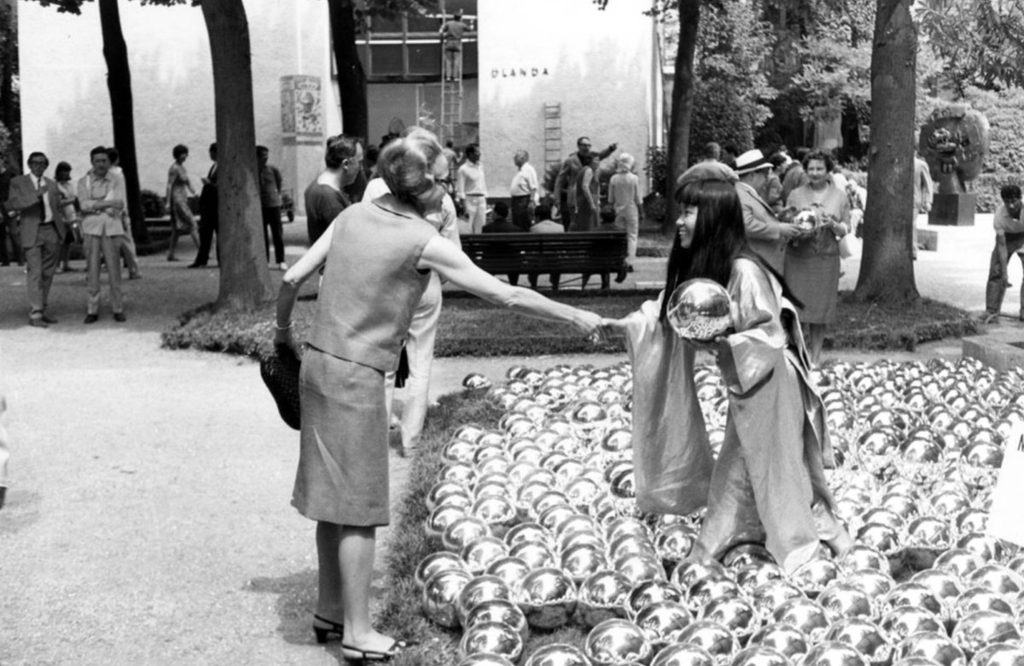
Given his intentions, Verhoeven places himself within an activist tradition represented by only a handful of performances during the Biennale’s first eighty years. The two best-known and earliest examples are those of the Futurist Filippo Tommaso Marinetti, who sought to shake sleepy Venice out of its torpor in 1910, and Yayoi Kusama. In 1966, Kusama offered for sale 1,500 reflective silver-coloured spheres, scattered on the ground in front of the Dutch and Italian pavilions, at the price of a hot dog, 2 dollars, thereby denouncing the commercial art world. She was dressed in a gold kimono. The title, Your Narcissism for Sale, implicated obviously everyone who was part of that damned art world. The action by the Dutch artist Franklin Aalders in 1980, which consisted of disturbing the water of the Canale di San Marco in front of the Giardini, was also intended as a wake-up call, once again directed at the city itself, which was at risk of sinking (2).
Other dystopian performances followed. The best known are undoubtedly Marina Abramović’s Balkan Baroque (1997) and Anne Imhof’s Faust (2017), presented in the German national pavilion, burdened—if not cursed—by its history, where Hans Haacke had previously drilled holes into the marble floor.
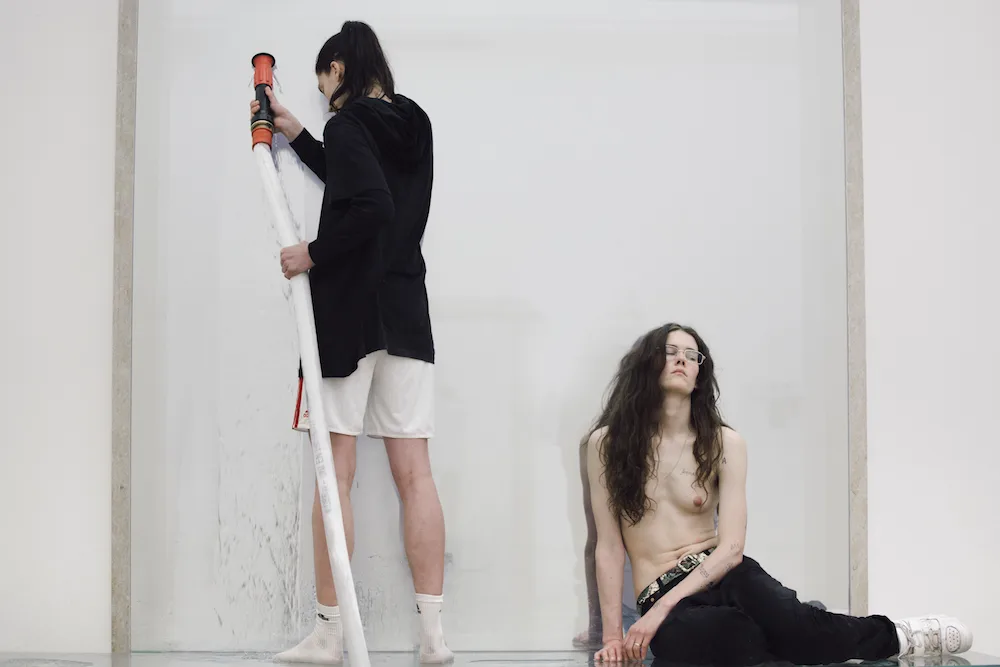
Photo: Nadine Fraczkowski
In the German pavilion, there was a glass floor constructed on which Anne Imhoff’s team performed. Beneath the floor were various props, such as a mattress, bottles, chains and sponges; the sterile room smelled of sanitary disinfectant. In the photo, on the right Eliza Douglas, Imhoff’s partner, and on the left Franziska Aigner (3).
As with Aalders and Haacke, Verhoeven seeks to impress upon visitors the reality of today’s disturbing or frightening situations, in his case primarely developments that threaten democratic society. He makes his position clear, while at the same time distancing himself from the concept underpinning this Biennale, which assigns the artist a different role. That role is implicit in the title given to the Biennale by Kouoh, Minor Keys, which has inspired many countries and proved a productive point of reference for them. It also informs, naturally, the two main exhibitions, curated by Kouoh and her team, in the Giardini and the Arsenale.
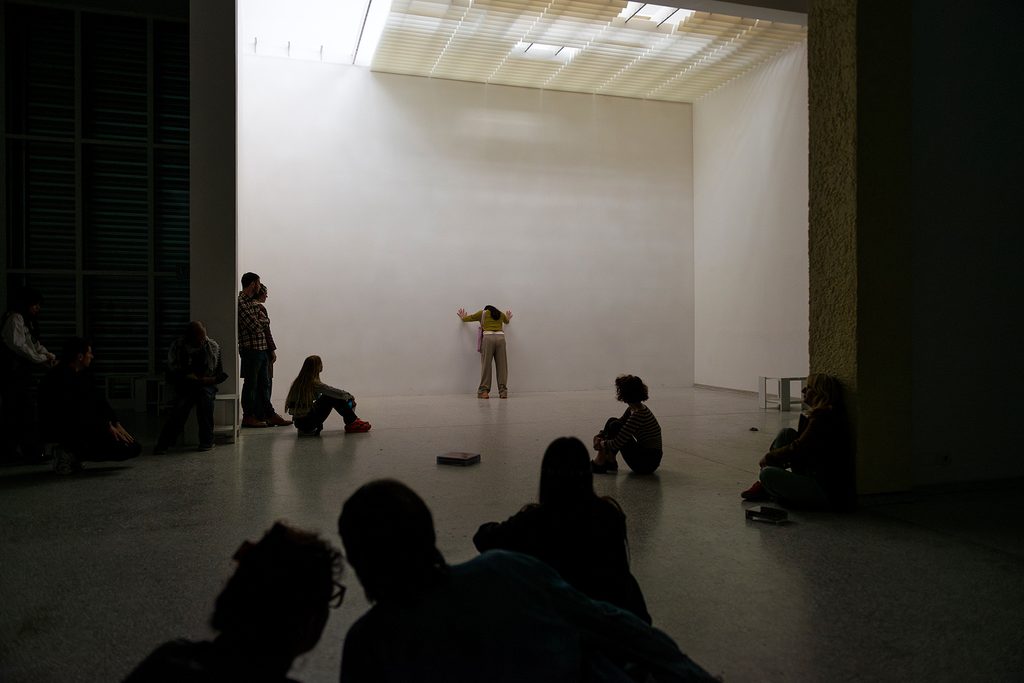
Photo: Willem Popelier.
Her response to the current crises is not to invoke musical keys that express melancholy and sorrow, but rather those that can lead us away from the cacophony and chaos of the present and return us to soothing tonalities and lower frequencies—to humming. And here the metaphor of the garden reappears: gardens, courtyards and other oases offer these. These, she concludes, are what we need in ‘terrible times’. Art can act as a ‘catalyst’ for ‘new relationships and possibilities’. It is hardly surprising that she chose this message: we recognize an old belief in the power of art, one that people are still all too willing to embrace, even now it has shed its messianic feathers. The keys remain minor. I found it particularly interesting to see how the other pavilions in the Giardini engaged with this idea, particularly those of Japan, Belgium and Austria, where performance was deployed in markedly different ways. In the Japanese pavilion, the heart-warming route through Grass Babies, Moon Babies, by the Japanese-American artist Ei Arakawa-Nash, invited interaction, whether or not one was carrying a baby doll of considerable weight. In the Belgian pavilion, Miet Warlop pursued two parallel tracks, bringing creation and destruction, as well as language, image and musical sounds, into dialogue; creation seemed ultimately to prevail.
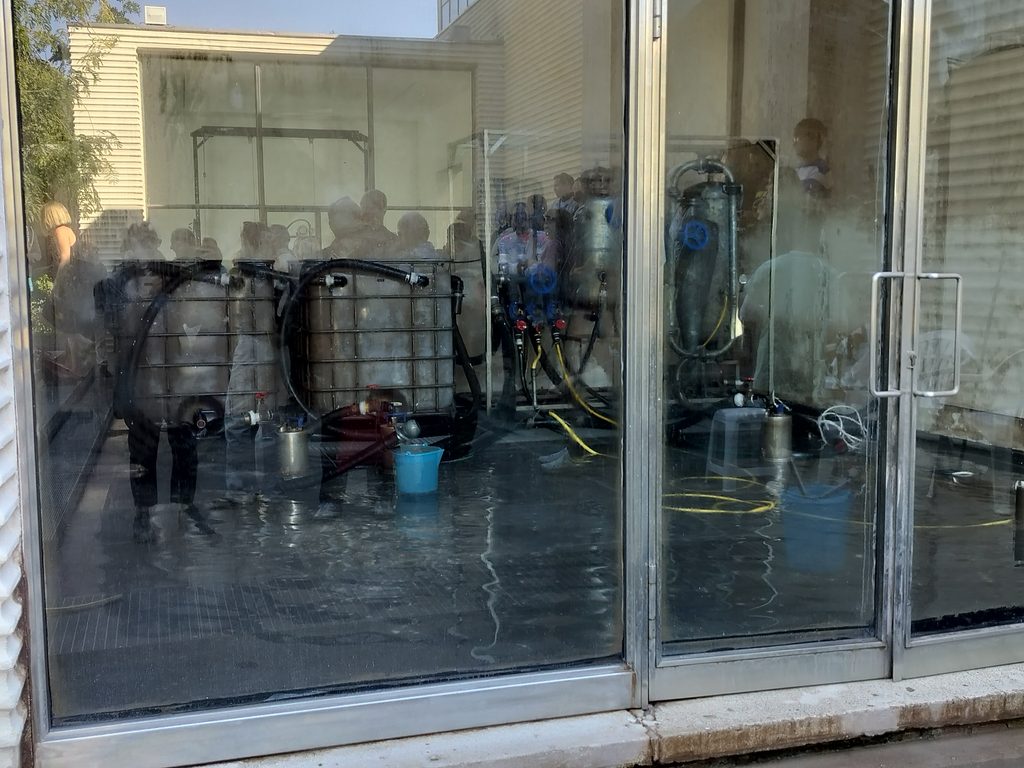
In the Austrian pavilion, a short walk past a series of dioramas led through Florentina Holzinger’s Sea World Factory, which translated the power of art into very literal terms through the acrobatic, In the Austrian pavilion, a short walk past a series of dioramas took visitors through Florentina Holzinger’s ‘Sea World Factory’, in which the power of art was expressed in a very literal way through the acrobatic, extremely demanding feats required of the female performers.
Alongside a small number of filmed performances—I am thinking of Merde in the Luxembourg pavilion, which particularly appealed to me— all these works act as oblique counter-voices within the 2026 edition of the Venice Biennale.
(1) The information and photographs on Verhoeven’s website – https://driesverhoeven.com – provide a good insight into the political and psychological impact of his earlier projects.
(2) Two years later, on the occasion of documenta 7 (1982), Aalders performed his Wasser-Latex-Mensch, invited by the Poryseidon Gallery in Kassel.
(3) See for a detailed description of the performances and the ideas behind Imhoff’s project, https://cdn.contemporaryartlibrary.org/store/doc/1823/docfile/original-5d8459cf7fcd4c8e3911cf2c84fb2c0b.pdf
mooi die verwijzingen naar de vroege performances!!
De performance van Ben d’ Armagnac werd begeleid door Louwrien Wijers die op bewonderenswaardige manier het publiek duidelijk maakte wat van hen verwacht werd: in stilte de performance bijwonen en tot het eind blijven, in de benauwde ruimte van de toren. Een publiek dat vermoedelijk voor een belangrijk deel niet vertrouwd was met performance kunst, wat wij dankzij De Appel wel waren.