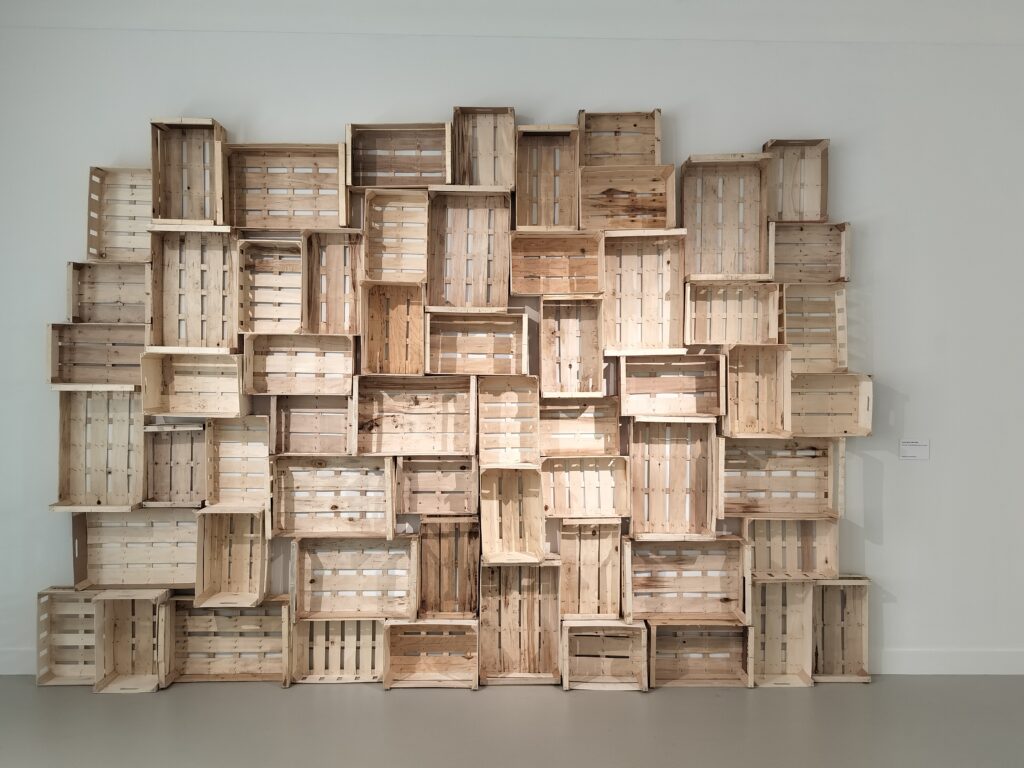
Installation of wooden vegetable crates
Courtesy Jan Henderikse
Photo: Marga van Mechelen
Once every few years, a new art museum is conceived in the Netherlands. Not every conception, however, leads to birth. More often than not, they revolve around the collections of private collectors, deemed museum-worthy—at least by their owners. One notable failure was the museum intended to house the Scheringa Collection. The 10,000-square-metre building, designed by Dok Architects, was almost completed, yet not a single painting has hung on its walls since its completion some fifteen years ago.
Another museum, also devoted to realist art, did succeed. Located in Gorssel, in the province of Gelderland, it has for many years enjoyed remarkable success. This is due not only to the quality of its collection but equally to the strength of its exhibition programme. I have always been able to see realist art in my home city of Arnhem and in Utrecht. It has never been at the centre of my own interests, yet I gladly travel to Museum MORE for its exhibitions, repeatedly surprised by the originality of its curatorial perspectives, the relevance of its themes, and the quality of the works on display. Establishing a museum without the security of a substantial collection, however, is an altogether different undertaking.
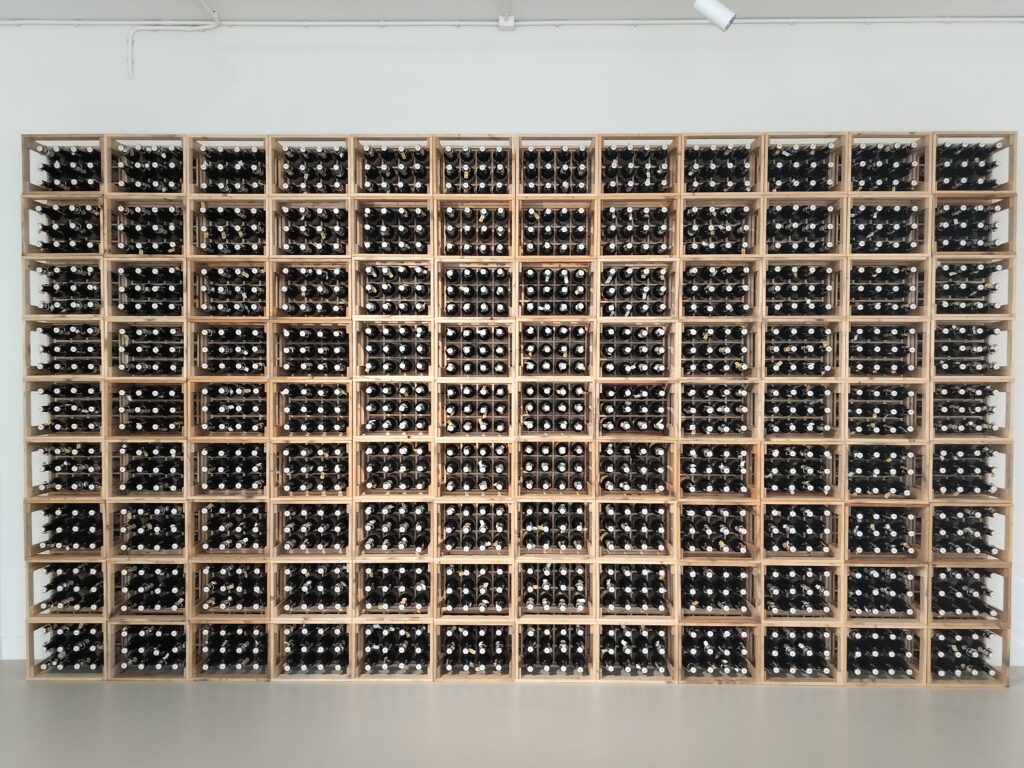
Installation of wooden beer crates
Courtesy BorzoGallery Amsterdam
Photo: Marga van Mechelen
Museum EICAS (European Institute for Contemporary Art and Science) began with a considerable disadvantage compared with Museum MORE. It possessed no collection of real significance and lacked a clearly defined profile, although from the outset it was evident that its focus would be non-figurative art—a field that can scarcely compete with realist art in terms of public appeal. Not even the wave of international interest in ZERO art some ten years ago altered that reality, although the museum’s founders may at the time have placed rather too much faith in that revival. The museum’s centre of gravity lies with the Dutch Nul Group and the wider ZERO movement, which, according to EICAS, continues to ‘echo in contemporary art’. That is an ambitious claim to substantiate. It explains why the museum regularly presents exhibitions of younger generations of non-figurative artists. Visitors with a degree of intellectual flexibility will undoubtedly recognise points of affinity. By extending its mission to forging connections between art and science—and even aspiring to become an experimental laboratory for innovation—the museum has hardly chosen the easiest path. Finally, and importantly, it initially lacked suitable permanent accommodation. Yet perseverance has prevailed. A dedicated body of volunteers has sustained the project, which has now been operating for some six years. With support from the municipality, the museum is today housed in a beautifully restored former grammar school—the Hegius Gymnasium and later the Municipal Secondary School for Girls—on Nieuwe Markt in Deventer.
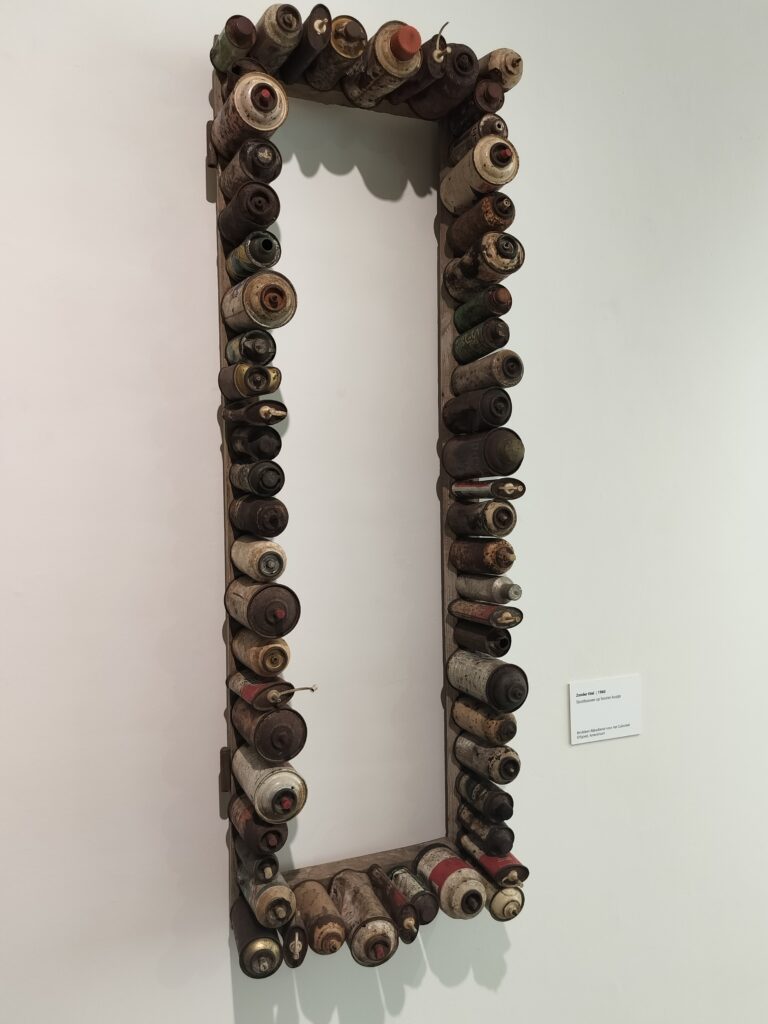
Metal spray cans on wooden frame, 120x44x20 cm
Collection Rijksdienst voor Cultureel Erfgoed Amersfoort
Photo: Marga van Mechelen
Since 12 May, the museum has been presenting Jan Henderikse: Super!, an exhibition devoted to an artist who has always preferred to describe himself as a Nieuwe Realist. On the museum’s website he is introduced as ‘the ideal artist for our museum’ and ‘the public’s favourite among the Nul artists’. I do not know on what evidence this assertion rests, yet there is some truth in it. Henderikse’s work possesses many of the qualities that made Pop Art so widely admired during the 1960s: colourful, playful, and built around objects appropriated from the world of consumer culture. The museum, for its part, suggests that these objects also invite a measure of critical reflection on that same consumer society. However, praise for these qualities sits somewhat uneasily with the museum’s profile.
Henderikse was one of the few Dutch artists included in Nieuwe Realisten [New Realists], the landmark exhibition organised by chief curator Wim Beeren at the Gemeentemuseum in The Hague in 1964. This ambitious international exhibition entered Dutch art history chiefly because it introduced Pop Art to a wider public. Earlier that same year, the museum had staged Zero-0-Nul, bringing together the Dutch artists Armando, Henk Peeters and Jan Schoonhoven alongside the German artists Otto Piene, Heinz Mack and Günther Uecker. By then Henderikse had already left the Nul Group. He had belonged to its core membership, but his contribution extended much further. In the autumn of 1958 it was Henderikse who first brought the future members together, at a time when they were all still producing Informal art. A few months later they adopted the name Holländische Informelle Gruppe. Henderikse also played an important role in establishing contact with the German ZERO group and with the art historian Udo Kultermann, who organised the influential exhibition Monochrome Malerei in Leverkusen in 1960.
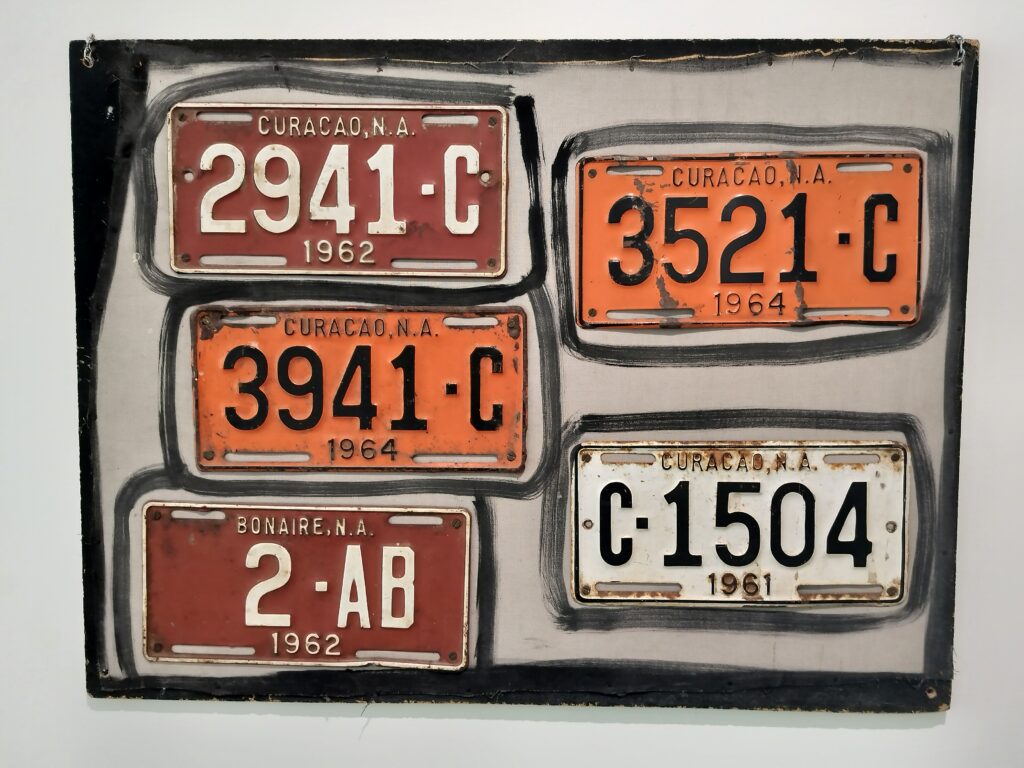
License plates on plywood panel
Collection Rüdiger K. Weng, Düsseldorf and Paris
Photo: Marga van Mechelen
Henderikse unquestionably belonged among the Nieuwe Realisten, although Beeren had initially also considered including a larger number of ZERO artists. His purpose was by no means to launch new artistic movements or to impose rigid art-historical distinctions between them. He understood the history of the ZERO movement and recognised the significance of Pop Art, but his principal aim was to demonstrate that artists on many different fronts had left lyrical and Abstract Expressionism behind. (1)
The exhibition includes the full-length documentary Alles is licht (All is Light), directed by Sherman De Jesus. Most of the footage was shot in New York around the year 2000. For a brief moment the film returns to the Netherlands—and further back in time—when Henderikse stands before the monochrome gravestone of Jan Schoonhoven, who died in 1994. Looking at the stone, he remarks that it ought to be cleaned: ‘Henk (Peeters) should do that.’ The comment makes perfect sense to anyone familiar with the internal dynamics of the group. Yet in those few words one senses the personal bond that continued to connect him with the other members—a bond that he ultimately had to sever in order to become the Nieuwe Realist he wished to be.
Museum MORE might do well to look around at EICAS.
Note
- More on this subject can be found in Essay 7, ‘Rotterdam Realism and the Introduction of Pop Art’, from my forthcoming book on the art of the 1960s. There I also argue that, for Wim Beeren, Minimal Art represented yet another ‘front’
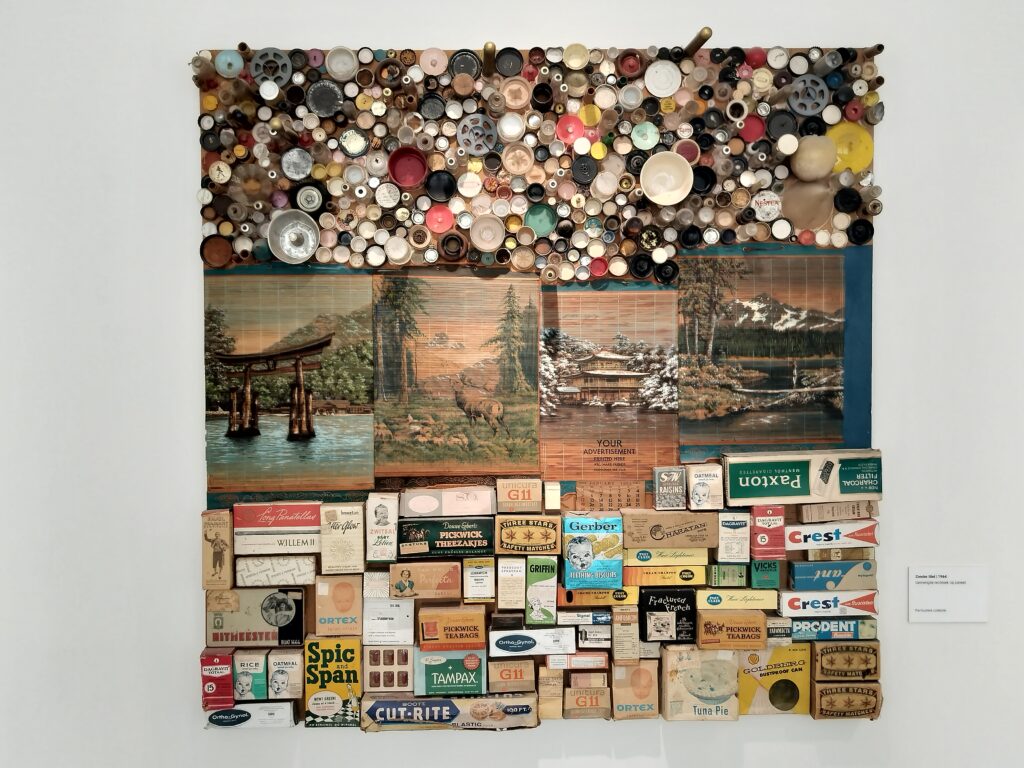
Mixed media on plywood panel, 122×122 cm
Private Collection
Photo: Marga van Mechelen