When is an artist an epigone, and when a follower? The distinction matters, because the former term carries an unfavorable connotation and is likely to be taken as an insult by the artist concerned. According to the conventional definition, an epigone is a follower who lacks originality and copies the ideas of others. But over the past forty-five years, under the influence of poststructuralism and postmodernism, have some of the sharp edges of this opposition not been worn away? In my teaching at the university, the value of originality, as well as that of uniqueness, was regularly called into question, although marketing and psychology operated then—and still do—according to different standards.
Originality and uniqueness were part of a triad, together with authenticity. But is that still the case? Looking back over the past few decades, I nevertheless find myself concluding that authenticity is a different matter. Although it was long mentioned in the same breath as originality and uniqueness, it seems to have weathered the criticism rather better, even if the syntaxis in which the term is used has changed. Once, people spoke of the authenticity of an artist’s work, often supplemented by the artist’s life story. Today, the emphasis is much more unequivocally on the subjective inner world: on the artist’s ‘genuine’, preferably even ‘urgent’, motivations. It recalls a Romantic notion, although the creative and divinely gifted genius is no longer embraced as it was in the nineteenth century.
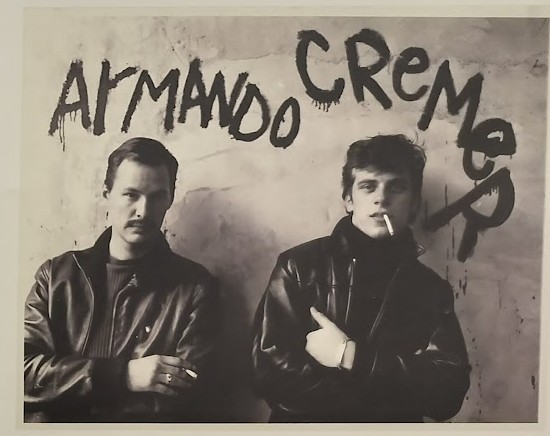
Photo published in Carrousel, 1, nr 3, 10 December 1960
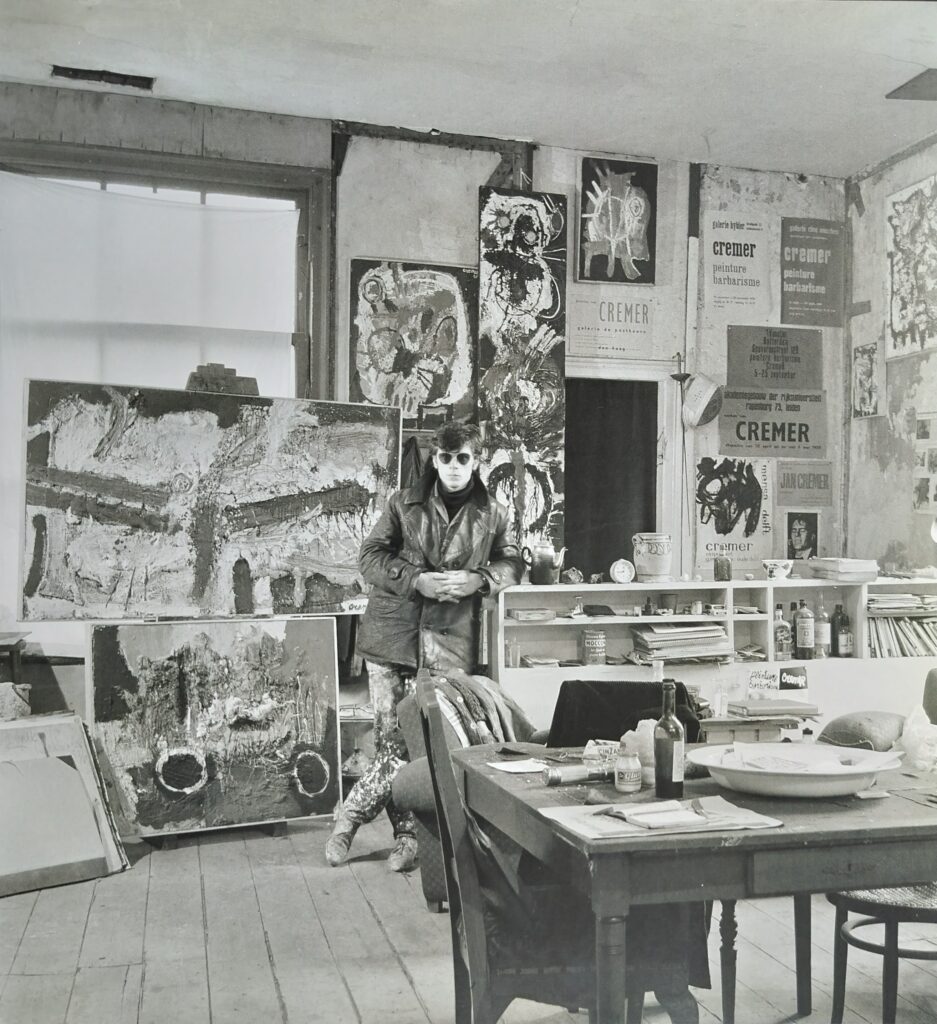
These thoughts occurred to me while visiting the Jan Cremer exhibition at Museum de Fundatie in Zwolle. The exhibition focuses on his early work and consists primarily of works from the museum’s collection or from the estate of his widow. It also includes photographs and works by other artists who played a role during his first years as a visual artist. The earliest works date from the second half of the 1950s, particularly 1959, when Cremer was nineteen. Two pictures from that year show him together with Armando, who was then thirty. Both are wearing leather jackets and look like contemporaries: streetwise boys, lookalikes in the style of the Dutch nozems. At the time, Cremer was in a relationship with Lotti van der Gaag, who was thirty-seven—‘although you wouldn’t have guessed it’—and lived in Paris, where she moved in CoBrA circles, yet was still not considered an equal by her male colleagues. Through her, Cremer came into contact with Karel Appel. Jan Vrijman had not yet made his famous film about Appel, but he had already released Appel’s now-famous declaration, ‘I just mess around,’ into the world. Cremer came up with variations of that phrase. At first, modestly: ‘I mess around a little.’ Later, more boldly: ‘I throw paint onto the canvas,’ or, when that seemed to go too far, ‘I fling paint onto the canvas.’ He readily adopted the wildness of Appel’s way of working; it became his label: Peinture Barbarisme.
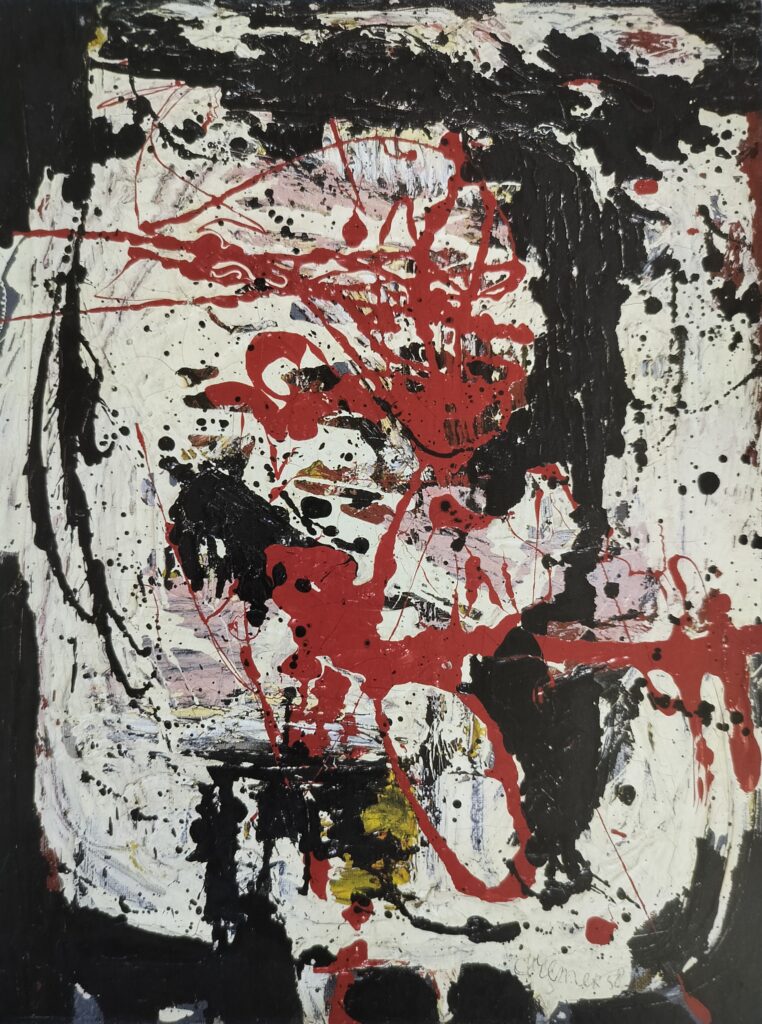
Composition 1958
Oil on canvas, 50 x 40 cm
Collection Museum De Fundatie, Zwolle
Around 1959, several expressive tendencies dominated the art world. Jackson Pollock played a role, clearly visible in Cremer’s use of the dripping technique. Like Pollock, Cremer worked on canvases laid out on the floor in his studio in The Hague in 1960, as a number of photographs show. Whether he had seen Hans Namuth’s famous 1952 film of Pollock at work, I do not know. One of the exhibition’s wall texts is entitled Peinture Barbarisme Wild Schilderen, a title whose linguistic construction I do not entirely understand. It was, however, clearly Cremer’s own invention, repeated countless times for all his exhibition announcements, always in the same layout and explained by him in his own texts, although the wall text seeks to broaden its scope by referring to other artists as well.
But is that justified? Was Cremer really part of the same zeitgeist as Armando or Appel? I have my doubts. Cremer’s statements may resemble those of Appel, but there is hardly any stylistic or iconographic similarity between their work. There is, however, such a similarity with Armando. In Cremer’s early work, titles, as in Armando’s, point toward the war. His paintings are dominated by red and black as well. The expressive manner in which the paint is applied is another point of resemblance, although the influence of Bram Bogart is more clearly evident.
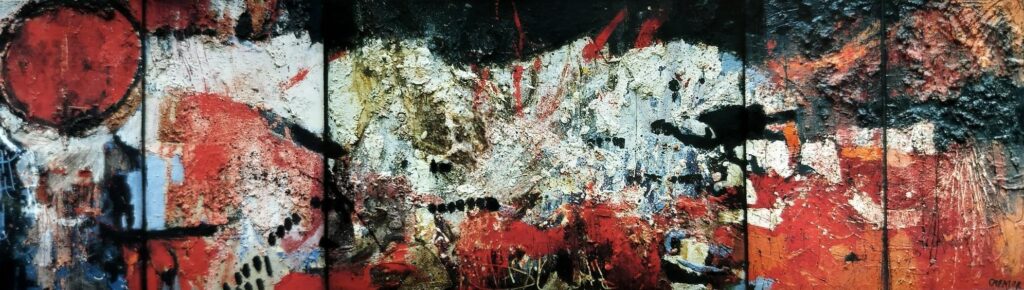
La Guerre Japonaise (five-panel work, 1960
Mixed Media,160 x 560 cm
Collection Museum De Fundatie, Zwolle
And yet…
Labelling would play a major role in the 1960s. Armando himself contributed to this process. In my book, due to be published in the course of next year, I devote considerable attention to the founding, by Armando, of the Holländische Informelle Gruppe in early 1959. Its other members were Jan Schoonhoven, Henk Peeters, Jan Henderikse and Kees van Bohemen. It was a small group that put itself on the map by choosing a highly controversial German title incorporating a French artistic movement—a label that, to make matters even more amusing, somehow evokes tulips or Dutch cheese. From a marketing perspective, it was a masterstroke. And yes, they succeeded. Not immediately in the Netherlands, but in the surrounding countries. It was a label with a cynical, defiant undertone, born out of frustration after all the rejection they had encountered from the art critics of the time. During the period of post-war reconstruction, they kept the memory of the war alive against the will of so many others. Initially, Jan Cremer rode along with them. He even produced an occasional white Informel work. But the cat was soon out of the bag when he launched his book Ik Jan Cremer, with the words ‘the relentless bestseller’ prominently displayed on the cover—exactly what it eventually became.
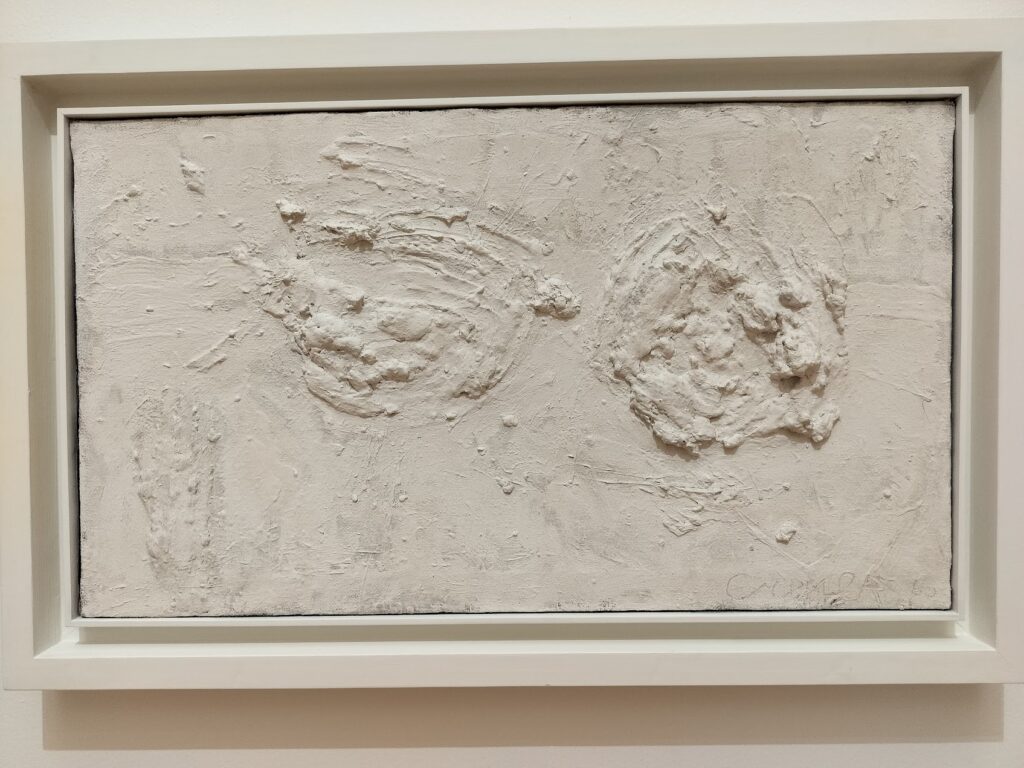
Mixed media on canvas
60 x 106 cm
Collection Museum De Fundatie, Zwolle
Seventy years later, Franck Gribling, who himself had gone through an Informel period, wrote that ‘self-promotion is a thing, and at the time it was something new and rather amusing, but it becomes something else when serious newspapers and critics start believing it and helping to disseminate it.’ Those newspapers and critics were already there in the 1960s. And collectors! I am thinking of Wim Beeren and Willem Sandberg, both of whom took an interest in the young, highly driven talent that he was. They would not have regarded him as an epigone. Rather, they saw him as an artist of a new bold generation. A ten-year age difference mattered in those days. It is no coincidence that the thread running through the reception of Armando’s work has become his reflection on the experience of war. And what in Cremer’s case? It is primarely the vivid colors and pop motifs of his later works that have come to define the image of him.
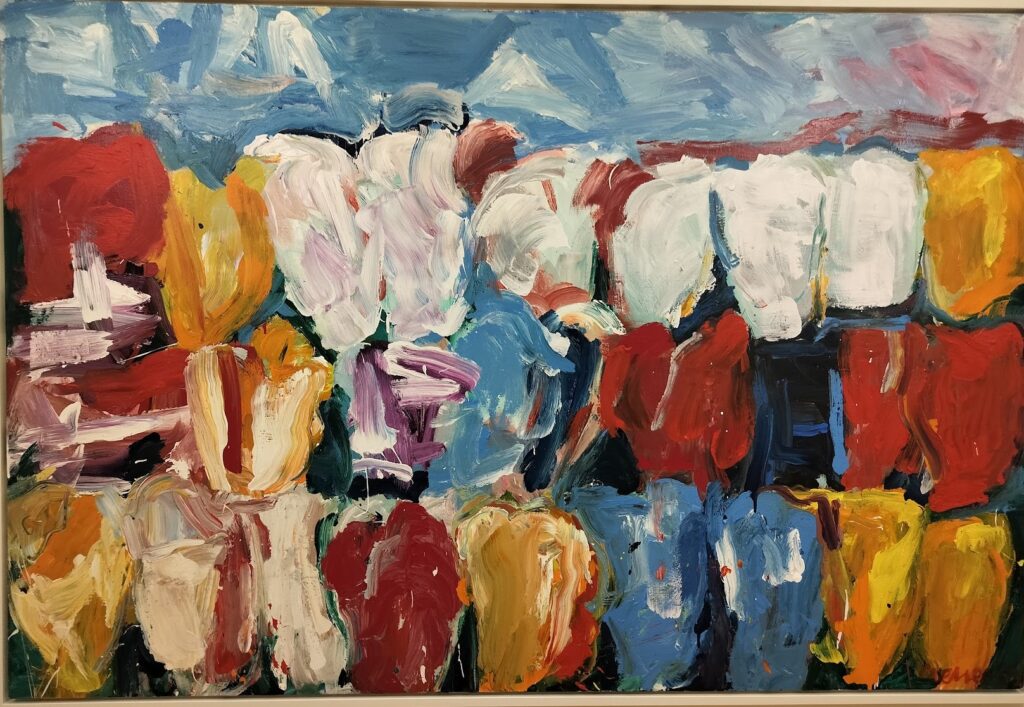
Oil on canvas, 153 x 229 cm
Collection Museum De Fundatie, Zwolle
A final note: artists may have taken labeling into their own hands in the 1960s, but the verdict of a ‘Keuringsdienst van Waarde’ is still necessary, even sixty-five years later. That was what I missed in Zwolle. (1)
(1) Keuringsdienst van Waarde is a program produced by Dutch public broadcaster NPO. It investigates whether the claims made by manufacturers—and the labels they use in their advertising—are actually true. In other words, a form of ‘domestic journalism’.